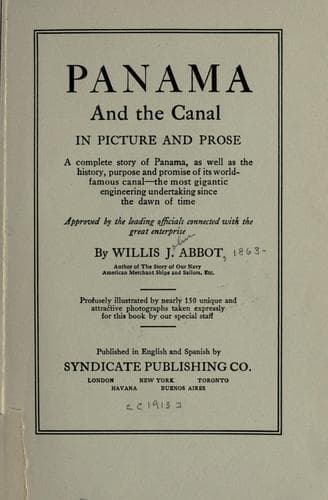
Panama and the Canal in Picture and ProseAbbot, Willis J. (Willis John)
History
Panama and the Canal in Picture and Prose
Abbot, Willis J. (Willis John)
Panama Canal (Panama) -- History
Amidst it all the work went on. So much stress has been laid upon the
riot in the towns that one forgets the patient digging out on the hills
and in the jungle. In 1912 the Secretary of the United States Canal
Commission estimated the amount of excavation done by the French, useful
to our canal, at 29,709,000 cubic yards worth $25,389,000. That by no
means represented all their work, for our shift in the line of the canal
made much of their excavation valueless. Between Gold Hill and
Contractor’s Hill in the Culebra Cut, where our struggle with the
obstinate resistance of nature has been fiercest, the French cut down
161 feet, all of it serviceable to us. Their surveys and plats are
invaluable, and their machinery, which tourists seeing some pieces
abandoned to the jungle condemn in the lump, has been of substantial
value to us both for use and for sale.
[Illustration: FILTH THAT WOULD DRIVE A BERKSHIRE FROM HIS STY
A typical scene in the negro quarters of Colon during the period of
French activity in Panama]
But under the conditions as they found them, the French could never have
completed the canal. Only a government could be equal to that task.
President Roosevelt found to his own satisfaction at least that neither
private contract nor civilian management was adequate. Most
emphatically, if the desire for profit was to be the sole animating
force the canal could never be built at all. When the discovery that
the canal enterprise would never be a “big bonanza” dawned on the French
stockholders distrust was rapidly succeeded by panic. Vainly did De
Lesseps repeat his favorite formula, “The canal will be built.” Vainly
did the officers of the company pay tribute to the blackmailers that
sprung up on every side--journalists, politicians, discharged employees,
every man who knew a weak point in the company’s armor. Reorganizations,
new stock issues, changes of plan, appeals for government aid, bond
issues, followed one after another. The sea-level canal was abandoned
and a lock canal substituted. After repeated petitions the French
Chamber of Deputies, salved with some of the spoil, authorized an issue
of lottery bonds and bankruptcy was temporarily averted. A new company
was formed but the work languished, just enough in fact being done to
keep the concession alive. After efforts to enlist the coöperation of
the United States, the company in despair offered to sell out altogether
to that government, and after that proffer the center of interest was
transferred from Paris to Washington.
[Illustration: _Photo by Underwood and Underwood_
CANAL VALLEY NEAR PEDRO MIGUEL
Through the line of hills in the background extends the deepest part of
the Culebra Cut]
The French had spent in all about $260,000,000 and sacrificed about 2000
French lives before they drew the fires from their dredges, left their
steam shovels in the jungle and turned the task over to the great
American Republic.
CHAPTER VII
THE UNITED STATES BEGINS WORK
Public-domain text, read in full here on John Shaqi.
Reviews
Reviews
No reviews yet
Be the first to share your thoughts on this work.
Elsewhere in the archive
Join the Discussion
Join the discussion
Sign in to leave a comment or review.
Sign InorCreate an account