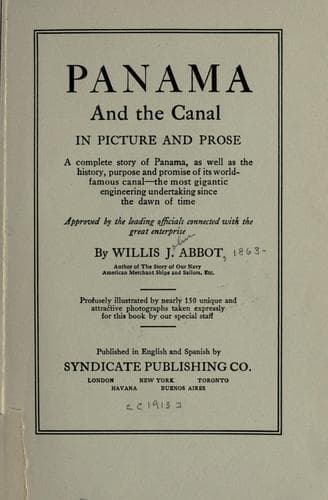
Panama and the Canal in Picture and ProseAbbot, Willis J. (Willis John)
History
Panama and the Canal in Picture and Prose
Abbot, Willis J. (Willis John)
Panama Canal (Panama) -- History
3. All railway and canal rights in the Zone are ceded to the United
States and its property therein is exempted from taxation.
4. The United States has the right to police, garrison and fortify the
Zone.
5. The United States is granted sanitary jurisdiction over the cities of
Panama and Colon, and is vested with the right to preserve order in the
Republic, should the Panamanian government in the judgment of the United
States fail to do so.
6. As a condition of the treaty the United States paid to Panama
$10,000,000 in cash, and in 1913 began the annual payment of $250,000 in
perpetuity.
Thus equipped with all necessary international authority for the work of
building the canal President Roosevelt plunged with equal vehemence and
audacity into the actual constructive work. If he strained to the
breaking point the rights of a friendly nation to get his treaty, he
afterwards tested even further the elasticity of the power of a
President to act without Congressional authority.
[Illustration: _Photo by Underwood & Underwood_
FRENCH DRY DOCK, CRISTOBAL]
We may hastily pass over the steps forward. Mr. Cromwell was paid the
$40,000,000 for the French stockholders, and at once there arose a
prodigious outcry that the Frenchmen got but little out of it; that
their stock had been bought for a few cents on the dollar by speculative
Americans; that these Americans had financed the “revolution” and that
some of the stock was held by persons very close to the administration.
None of these charges was proved, but all left a rather bad impression
on the public mind. However the United States received full value for
the money. April 28, 1904, Congress appropriated the $10,000,000 due
Panama, and with the title thus clear Lieutenant Mark Brooke, U. S. A.,
at 7:30 A. M. May 4th, formally took over the territory in the name of
the United States. An excellent opportunity for pomp and ceremony, for
fuss and feathers was thus wasted. There were neither speeches, nor
thundering salutes and the hour was obviously unpropitious for
champagne. “They order these things better in France,” as “Uncle Toby”
was wont to say.
[Illustration: WHAT THE WORK EXPENDED ON THE CANAL MIGHT HAVE DONE
Build a Chinese wall from San Francisco to New York, or dig a ditch 10
feet deep and 55 feet wide across the United States at its widest part]
When little more than a decade shall have rolled away after that wasted
ceremonial moment the visitor to the Isthmus will gaze upon the greatest
completed public work of this or any other past age. To conceive of some
task that man may accomplish in future that will exceed in magnitude
this one is in itself a tax upon the most vivid imagination. To what
great work of the past can we compare this one of the present?
[Illustration: _Courtesy Scientific American_
A GRAPHIC COMPARISON
The “spoil” taken from the canal would build 63 pyramids the size of
Cheops in Broadway from the Battery to Harlem]
Public-domain text, read in full here on John Shaqi.
Reviews
Reviews
No reviews yet
Be the first to share your thoughts on this work.
Elsewhere in the archive
Join the Discussion
Join the discussion
Sign in to leave a comment or review.
Sign InorCreate an account