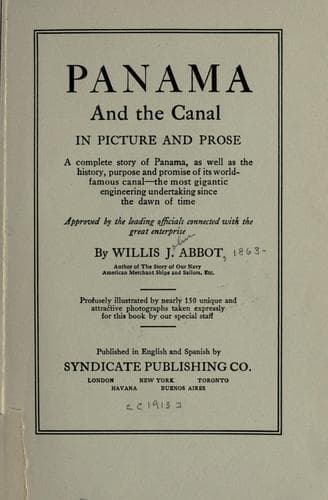
Panama and the Canal in Picture and ProseAbbot, Willis J. (Willis John)
History
Panama and the Canal in Picture and Prose
Abbot, Willis J. (Willis John)
Panama Canal (Panama) -- History
At the other end of the line the situation was more serious and might
well have caused bloodshed. Col. Torres, in charge of the troops there,
on hearing the news from Panama demanded a train at once, threatening
that unless it was furnished he would attack the Americans in the town.
He had more than 400 armed men, while on the “Nashville” were but 192
marines. In such a contest the Colombians could have relied upon much
assistance from the natives. With a guard of 42 marines employees of the
railroad prepared its stone freight house for defense while American
women and children were sent to vessels in the harbor. The Colombian
colonel had fixed two o’clock as the hour for beginning hostilities but
when that time arrived he invited a conference, and it was finally
agreed that both parties should retire from Colon, while he went to
Panama to consult with the jailed generals. During his absence the
“Dixie” arrived with 400 marines, and a little later the “Atlanta” with
1000. With this overwhelming force against him Col. Torres recognized
that the United States was back of the railroad’s refusal of
transportation and so yielded. With his troops he sailed again for
Cartagena.
[Illustration: HINDOO MERCHANTS ON THE ZONE]
Two days after the revolution--bloodless save for the sleeping
Chinaman--the United States recognized the Republic of Panama. Twelve
days later, with M. Bunau-Varilla who had by cable been appointed
minister to Washington, a treaty was concluded by which the United
States was granted all it desired for the furtherance of the canal
project. Much of the subsequent time of President Roosevelt was taken up
in arguing that he had not gone beyond the proper bounds of diplomacy in
getting this advantage, but the world though accepting the result has
ever been incredulous of his protestations of good faith. And the end is
not yet. Colombia has not condoned the part taken by the United States,
and the State Department has long been endeavoring to discover some way,
not too mortifying to our national self-esteem, by which we may allay
Colombia’s discontent. And as for that nation it has persistently
refused to recognize Panama as independent, one of the results of which
has been that the perpetrators of crime on the Isthmus may skip blithely
over the line to Bogotá or Cartagena and enjoy life free from dread of
extradition.
[Illustration: CHAME BEACH, PACIFIC COAST
Where sand is obtained for locks on the Pacific division]
Briefly summarized the terms of the treaty thus expeditiously secured
are:
1. The guaranty of the independence of the Republic of Panama.
2. The grant to the United States of a strip of land from ocean to
ocean, extending for five miles on each side of the canal, to be called
the Canal Zone and over which the United States has absolute
jurisdiction. From this Zone the cities of Panama and Colon are
explicitly excluded.
Public-domain text, read in full here on John Shaqi.
Reviews
Reviews
No reviews yet
Be the first to share your thoughts on this work.
Elsewhere in the archive
Join the Discussion
Join the discussion
Sign in to leave a comment or review.
Sign InorCreate an account