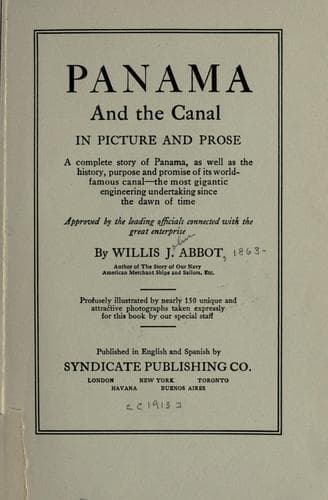
Panama and the Canal in Picture and ProseAbbot, Willis J. (Willis John)
History
Panama and the Canal in Picture and Prose
Abbot, Willis J. (Willis John)
Panama Canal (Panama) -- History
Up to this time the ship had been proceeding under her own steam and at
about full speed. Now slowing down she gradually comes to a full stop
alongside the central guide wall. Here will be waiting four electric
locomotives, two on the central, two on the side wall. Made fast, bow
and stern, the satellites start off with the ship in tow. It will take
an hour and a half to pass the three locks at Gatun and arrangements
will probably be made for passengers to leave the ship and walk by its
side if desired, as it climbs the three steps to the waters of Gatun
Lake 85 feet above.
Probably the first thing the observant passenger will notice is that as
the ship steams into the open lock the great gates which are to close
behind her and hold the water which flows in from below, slowly lifting
her to the lock above, are folded flush with the wall, a recess having
been built to receive them. The chamber which the vessel has entered is
1000 feet long, if the full water capacity be employed, 110 feet wide
and will raise the ship 28¹⁄₃ feet. If the ship is a comparatively small
one the full length of the lock will not be used, as intermediate gates
are provided which will permit the use of 400 or 600 feet of the lock as
required--thus saving water, which means saving power, for the water
that raises and lowers the ships also generates electric power which
will be employed in several ways.
Back of each pair of gates is a second pair of emergency gates folded
back flush with the wall and only to be used in case of injury to the
first pair. On the floor of the canal at the entrance to the lock lies a
great chain, attached to machinery which, at the first sign of a ship’s
becoming unmanageable, will raise it and bar the passage. Nearly all
serious accidents which have occurred to locks have been due to vessels
of which control has been lost, by some error in telegraphing from the
bridge to the engine room. For this reason at Panama vessels once in the
locks will be controlled wholly by the four locomotives on the lock
walls which can check its momentum at the slightest sign of danger.
Their own engines will be shut down. Finally at the upper entrance to
the locks is an emergency dam built on the guide wall. It is evident
that if an accident should happen to the gates of the upper lock the
water on the upper level would rush with destructive force against the
lower ones, perhaps sweeping away one after the other and wrecking the
canal disastrously. To avert this the emergency dams are swung on a
pivot, something like a drawbridge, athwart the lock and great plates
let down one after the other, stayed by the perpendicular steel
framework until the rush of the waters is checked. A caisson is then
sunk against these plates, making the dam complete.
Public-domain text, read in full here on John Shaqi.
Reviews
Reviews
No reviews yet
Be the first to share your thoughts on this work.
Elsewhere in the archive
Join the Discussion
Join the discussion
Sign in to leave a comment or review.
Sign InorCreate an account