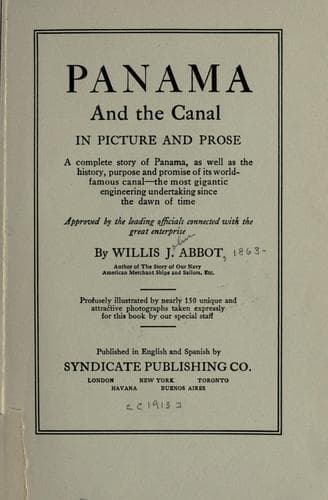
Panama and the Canal in Picture and ProseAbbot, Willis J. (Willis John)
History
Panama and the Canal in Picture and Prose
Abbot, Willis J. (Willis John)
Panama Canal (Panama) -- History
The method of construction and operation of these locks will be more
fully described in a later chapter. What has been outlined here can be
fully observed, by the voyager in transit. The machinery by which all is
operated is concealed in the masonry crypts below, but the traveler may
find cheer and certainty of safety in the assurance of the engineer who
took me through the cavernous passages--“It’s all made fool proof”.
[Illustration: _Photo by Underwood & Underwood_
LOCK AT PEDRO MIGUEL UNDER CONSTRUCTION
The picture shows strikingly the construction of the locks in pairs, the
inner pair being for precautionary purposes]
[Illustration: RANGE TOWER AT PACIFIC ENTRANCE]
Leaving the Gatun locks and going toward the Pacific the ship enters
Gatun Lake, a great artificial body of water 85 feet above tide water.
This is the ultimate height to which the vessel must climb, and it has
reached it in the three steps of the Gatun locks. To descend from Gatun
Lake to the Pacific level she drops down one lock at Pedro Miguel, 30¹⁄₃
feet; and two locks at Miraflores with a total descent of 54²⁄₃ feet.
Returning from the Pacific to the Atlantic the locks of course are taken
in reverse order, the ascent beginning at Miraflores and the complete
descent being made at Gatun. Gatun Lake constitutes really the major
part of the canal, and the channel through it extends in a somewhat
tortuous course for about twenty-four miles. So broad is the channel
dredged--ranging from 500 to 1000 feet in width and 45 to 85 in
depth--that vessels will proceed at full speed, a very material
advantage, as in ordinary canals half speed or even less is prescribed
in order to avoid the erosion of the banks.
The lake which the voyager by Panama will traverse will in time become a
scenic feature of the trip that cannot fail to delight those who gaze
upon it. But for some years to come it will be ghastly, a living
realization of some of the pictures emanating from the abnormal brain of
Gustave Doré. On either side of the ship gaunt gray trunks of dead trees
rise from the placid water, draped in some instances with the Spanish
moss familiar to residents of our southern states, though not abundant
on the Isthmus. More of the trees are hung with the trailing ropes of
vines once bright with green foliage and brilliant flowers, now gray and
dead like the parent trunk. Only the orchids and the air plants will
continue to give some slight hint of life to the dull gray monotony of
death. For a time, too, it must be expected that the atmosphere will be
as offensive as the scene is depressing, for it has been found that the
tropical foliage in rotting gives out a most penetrating and
disagreeable odor. The scientists have determined to their own
satisfaction that it is not prejudicial to health, but the men who have
been working in the camps near the shores of the rising lake declare it
emphatically destructive of comfort.
Public-domain text, read in full here on John Shaqi.
Reviews
Reviews
No reviews yet
Be the first to share your thoughts on this work.
Elsewhere in the archive
Join the Discussion
Join the discussion
Sign in to leave a comment or review.
Sign InorCreate an account