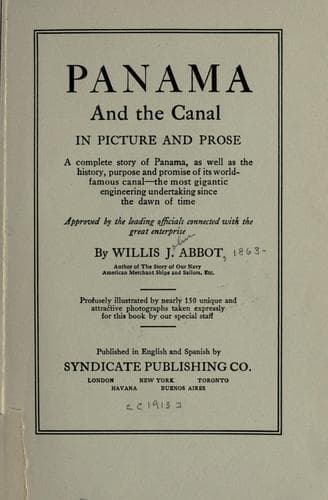
Panama and the Canal in Picture and ProseAbbot, Willis J. (Willis John)
History
Panama and the Canal in Picture and Prose
Abbot, Willis J. (Willis John)
Panama Canal (Panama) -- History
“Col. Goethals: ‘Yes, sir. We need a good club house, because we
should give them some amusement, and keep them out of Panama. I
believe in the club-house principle.’
“The Chairman: ‘That is all right, but you must contemplate a very
elaborate house?’
“Col. Goethals: ‘Yes, sir. I want to make a town there that will be a
credit to the United States government.’”
Looking out to sea from the prow of a ship entering the Pacific Ocean
you will notice three conical islands rising abruptly from the waves,
to a height of three or four hundred feet. To be more precise the one
nearest the shore ceased to be an island when the busy dirt trains of
the Canal Commission dumped into the sea some millions of cubic yards of
material taken from the Culebra Cut, forming at once a great area of
artificial land which may in ensuing centuries have its value, and a
breakwater which intercepts a local current that for a time gave the
canal builders much trouble by filling the channel with silt. The three
islands, Naos, Flamenco, and Perico are utilized by the United States as
sites for powerful forts. The policy of the War Department necessarily
prevents any description here of the forts planned or their armament.
Every government jealously guards from the merely curious a view of its
defensive works, and the intruder with a camera, however harmless and
inoffensive he may be, is severely dealt with as though he had profaned
the Holy of Holies. Despite these drastic precautions against the
harmless tourist it is a recognized fact that every government has in
its files plans and descriptions of the forts of any power with which it
is at all likely to become involved in war.
[Illustration: _Photo by Underwood & Underwood_
THE PACIFIC GATEWAY
The gun points to canal entrance; high hills in the background are
beyond the canal]
It may be said, however, without entering into prohibited details, that
by the fortifications on the islands, and on the hills adjacent to the
canal entrance, as well as by a permanent system of submarine mines the
Pacific entrance to the canal is made as nearly impregnable as the art
of war permits. The locks at Miraflores are seven miles inland and the
effective range of naval guns is fourteen miles, so that but for the
fortifications and a fleet of our own to hold the hostile fleet well out
to sea the very keystone of the canal structure would be menaced. Our
government in building its new terminal city at Balboa had before it a
very striking illustration of the way in which nations covet just such
towns. Russia on completing her trans-Siberian railroad built at Port
Arthur a terminal even grander and more costly than our new outpost on
the Pacific. But the Japanese flag now waves over Port Arthur--and
incidentally the fortifications of that famous terminal were also
considered impregnable. Perhaps the impregnable fort like the unsinkable
ship is yet to be found.
Public-domain text, read in full here on John Shaqi.
Reviews
Reviews
No reviews yet
Be the first to share your thoughts on this work.
Elsewhere in the archive
Join the Discussion
Join the discussion
Sign in to leave a comment or review.
Sign InorCreate an account