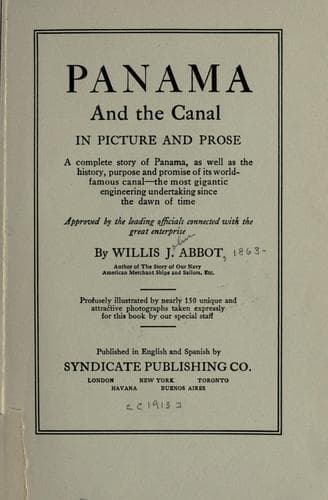
Panama and the Canal in Picture and ProseAbbot, Willis J. (Willis John)
History
Panama and the Canal in Picture and Prose
Abbot, Willis J. (Willis John)
Panama Canal (Panama) -- History
At Balboa the trip through the completed canal will be ended. It has
covered a fraction over fifty miles, and has consumed, according to the
speed of the ship and the “smartness” of her handling in locks, from
seven to ten hours. He who was fortunate enough to make that voyage may
well reflect on the weeks of time and the thousands of tons of coal
necessary to carry his vessel from Colon to Balboa had the canal not
existed.
[Illustration: _Photo by Underwood & Underwood_
COMPLETED CANAL AT COROZAL]
From Balboa to the ancient and yet gay city of Panama runs a trolley
line by which the passenger, whose ship remains in port for a few days,
or even a few hours, may with but little cost of time or money visit one
of the quaintest towns on the North American continent. If the climate,
or the seemingly ineradicable sluggishness of the Panamanian do not
intervene the two towns should grow into one, though their governments
must remain distinct, as the Republic of Panama naturally clings to its
capital city. But seemingly the prospect of a great new port at his
doors, open to the commerce of all the world, where ships from Hamburg
and Hong Kong, from London and Lima, from Copenhagen and from Melbourne
may all meet in passing their world-wide ways, excites the Panamanian
not a whit. He exists content with his town as it is, reaching out but
little for the new trade which this busy mart next door to him should
bring. No new hotels are rising within the line of the old walls; no new
air of haste or enterprise enlivens the placid streets and plazas.
Perhaps in time Balboa may be the big town, and Panama as much outworn
as that other Panama which Morgan left a mere group of ruins. It were a
pity should it be so, for no new town, built of neat cement blocks, with
a Y. M. C. A. club house as its crowning point of gaiety, can ever have
the charm which even the casual visitor finds in ragged, bright-colored,
crowded, gay and perhaps naughty Panama.
CHAPTER VIII
THE FORMATIVE PERIOD
American control of the canal, as I have already pointed out, was taken
over without any particular ceremony immediately after the payment to
Panama of the $10,000,000 provided for in the treaty. Indeed so slight
was the friction incident to the transfer of ownership from the French
to the Americans that several hundred laborers employed on the Culebra
Cut went on with their work serenely unconscious of any change in
management. But though work was uninterrupted the organization of the
directing force took time and thought. It took more than that. It
demanded the testing out of men in high place and the rejection of the
unfit; patient experimenting with methods and the abandonment of those
that failed to produce results. There was a long period of this
experimental work which sorely tried the patience of the American people
before the canal-digging organization fell into its stride and moved on
with a certain and resistless progress toward the goal.
Public-domain text, read in full here on John Shaqi.
Reviews
Reviews
No reviews yet
Be the first to share your thoughts on this work.
Elsewhere in the archive
Join the Discussion
Join the discussion
Sign in to leave a comment or review.
Sign InorCreate an account