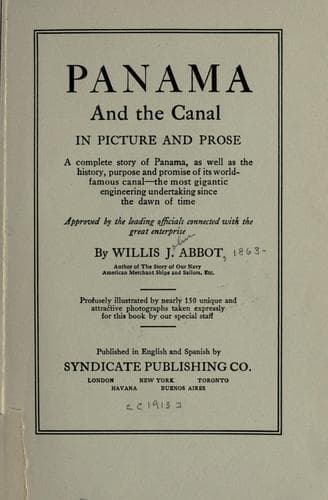
Panama and the Canal in Picture and ProseAbbot, Willis J. (Willis John)
History
Panama and the Canal in Picture and Prose
Abbot, Willis J. (Willis John)
Panama Canal (Panama) -- History
Despite the unfortunate circumstances attending Mr. Wallace’s
retirement, his work had been good, so far as it went. In office a
little more than a year he had spent more than three months of the time
in Washington or at sea. But he had made more than a beginning in
systematizing the work, in repairing the railroad, in renovating the old
machinery and actually making “the dirt fly”. Of that objectionable
substance--on the line of the canal, if anywhere, they applaud the
definition “dirt is matter out of place”--he had excavated 744,644
yards. Not much of a showing judged by the records of 1913, but
excellent for the machinery available in 1905. The first steam shovel
was installed during his régime and before he left nine were working.
The surveys, under his direction, were of great advantage to his
successor who never failed to acknowledge their merit.
[Illustration: HOSPITAL BUILDINGS, UNITED FRUIT CO.]
Mr. Stevens, who reached the canal, adopted at the outset the wise
determination to reduce construction work to the minimum and concentrate
effort on completing arrangements for housing and feeding the army of
workers which might be expected as soon as the interminable question of
the sea level or lock canal could be finally determined. From his
administration dates much of the good work done in the organization of
the Commissary and Subsistence Department, and the development of the
railroad. The inducement of free quarters added to high wages to attract
workers also originated with him. At the same time Gov. Magoon was
working over the details of civil administration, the schools, courts,
police system and road building. The really fundamental work of canal
building, the preparation of the ground for the edifice yet to be
erected, made great forward strides at this period. But the actual
record of excavation was but small.
[Illustration: _Photo by Underwood & Underwood_
BEGINNING THE NEW DOCKS, CRISTOBAL]
One reason for this was the hesitation over the type of canal to be
adopted. It is obvious that several hundred thousand cubic yards of dirt
dug out of a ditch have to be dumped somewhere. If deposited at one
place the dump would be in the way of a sea-level canal while
advantageous for the lock type. At another spot this condition would be
reversed. Already the Americans had been compelled to move a second time
a lot of spoil which the French had excavated, and which, under the
American plans, was in danger of falling back into Culebra Cut. “As a
gift of prophecy is withheld from us in these latter days,” wrote
Stevens plaintively in reference to the vacillation concerning the
plans, “all we can do now is to make such arrangements as may look
proper as far ahead as we can see.”
Public-domain text, read in full here on John Shaqi.
Reviews
Reviews
No reviews yet
Be the first to share your thoughts on this work.
Elsewhere in the archive
Join the Discussion
Join the discussion
Sign in to leave a comment or review.
Sign InorCreate an account