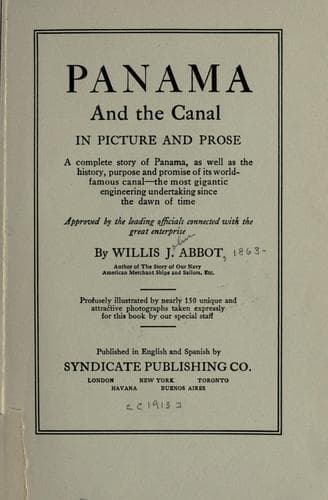
Panama and the Canal in Picture and ProseAbbot, Willis J. (Willis John)
History
Panama and the Canal in Picture and Prose
Abbot, Willis J. (Willis John)
Panama Canal (Panama) -- History
“My reason was, that I was made jointly responsible with Mr. Shonts and
Mr. Magoon for work on the canal, while Mr. Shonts had a verbal
agreement with the President that he should have a free rein in the
management of all matters. I felt Mr. Shonts was not as well qualified
as I was either as a business man or an administrator, and he was not an
engineer.... I thought it better to sacrifice my ambitions regarding
this work, which was to be the crowning event of my life, than remain to
be humiliated, forced to disobey orders, or create friction.”
[Illustration: A STREET AFTER PAVING
Before paving it was of the sort shown on page 39]
The Wallace resignation was at the moment most unfortunate. There had
for months been an almost concerted effort on the part of a large and
influential section of the press, and of men having the public ear to
decry the methods adopted at Panama, to criticize the men engaged in the
work and to magnify the obstacles to be overcome. Perhaps this chorus of
detraction was stimulated in part by advocates of the Nicaragua route
hoping to reopen that controversy. Probably the transcontinental
railroads, wanting no canal at all, had a great deal to do with it. At
any rate it was loud and insistent and the men on the Isthmus were
seriously affected by it. They knew by Mr. Wallace’s long absence that
some trouble was brewing in Washington. His sudden departure again after
his return from the capital and the rumor that he had determined to take
a more profitable place added to the unrest. Probably the rather severe
letter of dismissal with which Secretary Taft met the Chief Engineer’s
letter of resignation, and the instantaneous appointment in his place of
John F. Stevens, long associated with James J. Hill in railroad
building, at a salary $5000 a year greater, was the best tonic for the
tired feeling of those on the Isthmus. It indicated that the President
thought those who had accepted positions of command on the Canal Zone
had enlisted for the war, and that they could not desert in the face of
the enemy without a proper rebuke. It showed furthermore that the loss
of one man would not be permitted to demoralize the service, but that
the cry familiar on the line of battle “Close up! Close up, men!
Forward”! was to be the rallying cry in the attack on the hills of
Panama.
[Illustration: STOCKADE FOR PETTY CANAL ZONE OFFENDERS]
Public-domain text, read in full here on John Shaqi.
Reviews
Reviews
No reviews yet
Be the first to share your thoughts on this work.
Elsewhere in the archive
Join the Discussion
Join the discussion
Sign in to leave a comment or review.
Sign InorCreate an account