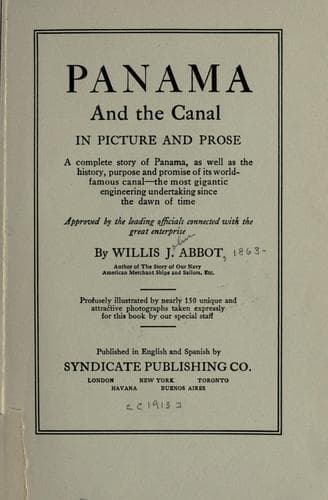
Panama and the Canal in Picture and ProseAbbot, Willis J. (Willis John)
History
Panama and the Canal in Picture and Prose
Abbot, Willis J. (Willis John)
Panama Canal (Panama) -- History
Chairman Shonts, himself a builder of long experience and well
accustomed to dealing with contractors, was firmly of the opinion that
the canal could best be built by letting contracts to private bidders
for the work. In this he was opposed by most of his associates, and
particularly by Mr. Stevens who had been working hard and efficiently to
build up an organization that would be capable of building the canal
without the interposition of private contractors looking for personal
profit. The employees on the Zone, naturally enough, were with Stevens
to a man, and time has shown that he and they were right. There is
something about working for the nation that stirs a man’s loyalty as
mere private employment never can. But in this instance Mr. Shonts was
in Washington, convenient to the ear of the President while Mr. Stevens
was on the Zone. Accordingly the President approved of the Chairman’s
plan, and directed the Secretary of War, Mr. Taft, to advertise for
bids. Mr. Stevens was discontented and showed it. That his judgment
would be justified in the end he could not know. That it had been set
aside for the moment he was keenly aware, and that he was being harassed
by Congress and by innumerable rules such as no veteran railroad builder
had ever been subjected to did not add to his comfort.
[Illustration: _Photo by Underwood & Underwood_
A DRILL BARGE AT WORK
The sea and tidal waters are underlaid with coral rock necessitating
much submarine blasting]
His complaints to the Secretary of War were many, and not of a sort to
contribute to that official’s peace of mind. When the bids came in from
the would-be contractors they were all rejected on the ground that they
did not conform to the specifications, but the real reason was that the
President at heart did not believe in that method of doing the work, and
was sure that the country agreed with him. This should have allayed Mr.
Stevens’ rising discontent. It certainly offended Chairman Shonts, who
stood for the contract system, and when the bids were rejected and that
system set aside promptly resigned. The President thereupon consolidated
the offices of Chairman of the Commission and Chief Engineer in one, Mr.
Stevens being appointed that one. Given thus practically unlimited power
Mr. Stevens might have been expected to be profoundly contented with the
situation. Instead he too resigned on the first of April, 1907.
[Illustration: _Photo by S. H. Elliott_
PACIFIC ENTRANCE TO THE CANAL]
About his resignation as about that of Mr. Wallace there has always been
a certain amount of mystery. He himself made no explanation of his act,
though his friends conjectured that he was not wholly in harmony with
the President’s plan to abolish the civilian commission altogether, and
fill its posts by appointments from the Army and Navy. On the Isthmus
there is a story that he did not intend to resign at all. Albert
Edwards, who heard the story early, tells it thus:
Public-domain text, read in full here on John Shaqi.
Reviews
Reviews
No reviews yet
Be the first to share your thoughts on this work.
Elsewhere in the archive
Join the Discussion
Join the discussion
Sign in to leave a comment or review.
Sign InorCreate an account