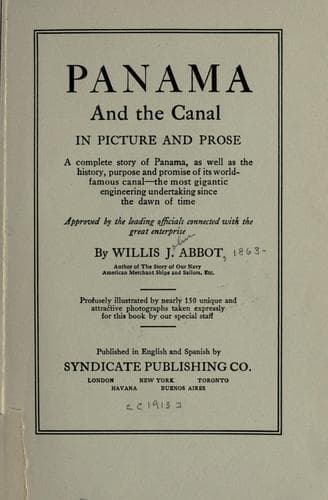
Panama and the Canal in Picture and ProseAbbot, Willis J. (Willis John)
History
Panama and the Canal in Picture and Prose
Abbot, Willis J. (Willis John)
Panama Canal (Panama) -- History
“One of the canal employees, who was on very friendly terms with
Stevens, came into his office and found him in the best of spirits. When
the business in hand was completed he said jovially:
“‘Read this. I’ve just been easing my mind to T. R. It’s a hot
one--isn’t it?’ And he handed over the carbon copy of his letter. His
visitor read it with great seriousness.
“‘Mr. Stevens’, he said, ‘that is the same as a resignation’.
“And Stevens laughed.
“‘Why, I’ve said that kind of thing to the Colonel a dozen times. He
knows I don’t mean to quit this job’.
“But about three hours after the letter reached Washington Mr. Stevens
received a cablegram: ‘Your resignation accepted’”.
At any rate the Stevens resignation called forth no such explosive
retort as had been directed against the unhappy Wallace, and he showed
no later signs of irritation, but came to the defense of his successor
in a letter strongly approving the construction of certain locks and
dams which were for the moment the targets of general public criticism.
Two weeks before Stevens resigned the other members of the Commission,
excepting Col. Gorgas, in response to a hint from the President had sent
in their resignations. Mr. Roosevelt had determined that henceforward
the work should be done by army and navy officers, trained to go where
the work was to be done and to stay there until recalled; men who had
entered the service of the nation for life and were not looking about
constantly to “better their conditions”. He had determined further that
the government should be the sole contractor, the only employer, the
exclusive paymaster, landlord and purveyor of all that was needful on
the Zone. In short he had planned for the Canal Zone a form of
administration which came to be called socialistic and gave cold chills
to those who stand in dread of that doctrine. To carry out these
purposes he appointed on April 1, 1907, the following commission:
Lieut.-Col. George W. Goethals, _Chairman and Chief Engineer_,
Major D. D. Gaillard, U. S. A.,
Major William L. Sibert, U. S. A.,
Mr. H. H. Rousseau, U. S. N.,
Col. W. C. Gorgas, U. S. A., Medical Corps,
Mr. J. C. S. Blackburn,
Mr. Jackson Smith,
Mr. Joseph Bucklin Bishop, _Secretary_.
A majority of this commission was in office at the time of publication
of this book, and gave evidences of sticking to the job until its
completion. Senator Blackburn resigned in 1910 and was succeeded by Hon.
Maurice H. Thatcher, also of Kentucky; and Mr. Smith retired in favor of
Lieut. Col. Hodges in 1908. In June, 1913, Commissioner Thatcher
resigned and was succeeded by Richard L. Metcalfe of Nebraska. With the
creation of this commission began the forceful and conclusive
administration of Col. Goethals, the man who finished the canal.
CHAPTER IX
COL. GOETHALS AT THE THROTTLE
Public-domain text, read in full here on John Shaqi.
Reviews
Reviews
No reviews yet
Be the first to share your thoughts on this work.
Elsewhere in the archive
Join the Discussion
Join the discussion
Sign in to leave a comment or review.
Sign InorCreate an account