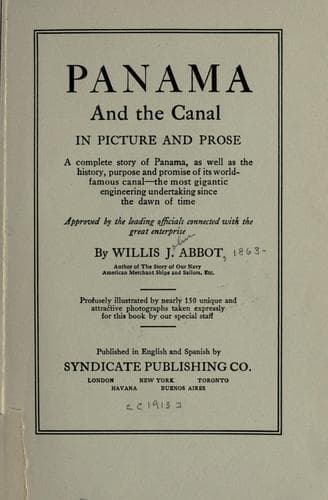
Panama and the Canal in Picture and ProseAbbot, Willis J. (Willis John)
History
Panama and the Canal in Picture and Prose
Abbot, Willis J. (Willis John)
Panama Canal (Panama) -- History
The visitor to the Canal Zone about 1913 could hardly spend a day in
that bustling community without becoming aware of some mighty potentate
not at all mysterious, but omnipresent and seemingly omniscient, to whom
all matters at issue were referred, to whom nothing was secret, whose
word was law and without whose countenance the mere presence of a
visitor on the Zone was impossible. The phrases most in use were “see
the Colonel,” “ask the Colonel” and “the Colonel says”. If there had
been a well-conducted newspaper on the Zone these phrases would have
been cast in slugs in its composing room for repeated and ready use. No
President of the United States, not even Lincoln in war times, exerted
the authority he daily employed in the zenith of his power. The
aggrieved wife appealed to his offices for the correction of her marital
woes, and the corporation with a $600,000 steam crane to sell talked
over its characteristics with the Colonel.
He could turn from a vexed question of adjusting the work of the steam
shovels to a new slide in the Culebra Cut, to compose the differences of
rival dancing clubs over dates at the Tivoli Hotel ball-room. On all
controverted questions there was but one court of last resort. As an
Isthmian poetaster put it:
“See Colonel Goethals, tell Colonel Goethals,
It’s the only right and proper thing to do.
Just write a letter, or even better
Arrange a little Sunday interview”.
Engineer Stevens in a speech made at the moment of his retirement before
a local club of workers said:
“You don’t need me any longer. All you have to do now is to dig a ditch.
What you want is a statesman”.
[Illustration: _Photo by Underwood & Underwood_
COL. GOETHALS AT HIS DESK]
A statesman was found and his finding exemplifies strikingly the fact
that when a great need arises the man to meet it is always at hand,
though frequently in obscurity. Major George W. Goethals of the General
Staff, stationed at Washington was far from being in the public eye.
Anyone who knows his Washington well knows that the General Staff is a
sort of general punching bag for officers of the Army who cannot get
appointments to it, and for newspaper correspondents who are fond of
describing its members as fusty bureaucrats given to lolling in the Army
and Navy Club while the Army sinks to the level of a mere ill-ordered
militia. But even in this position Major Goethals had not attained
sufficient eminence to have been made a target for the slings and arrows
of journalistic criticism. As a member of the Board of Fortifications,
however, he had attracted the attention of Secretary Taft, and through
him had been brought into personal relations with President Roosevelt.
[Illustration: _Photo by Underwood & Underwood_
RAILWAY STATION AT GATUN
The Panama Railroad is being equipped with stations and rolling stock of
the first-class]
Public-domain text, read in full here on John Shaqi.
Reviews
Reviews
No reviews yet
Be the first to share your thoughts on this work.
Elsewhere in the archive
Join the Discussion
Join the discussion
Sign in to leave a comment or review.
Sign InorCreate an account