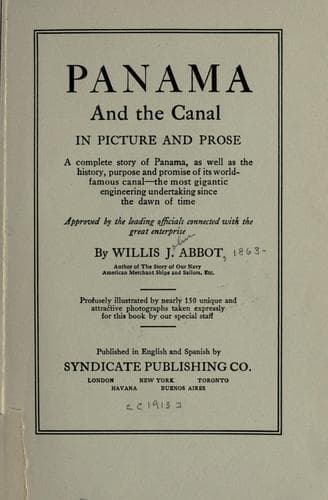
Panama and the Canal in Picture and ProseAbbot, Willis J. (Willis John)
History
Panama and the Canal in Picture and Prose
Abbot, Willis J. (Willis John)
Panama Canal (Panama) -- History
The first step in the construction of the dam was to dam the Chagres
then flowing through its old channel near the site chosen for the
spillway, and through the old French canal. This was accomplished by
building parallel walls, or “toes” of broken stone and filling the space
between with fluid mud pumped from the old channel of the stream. A new
channel of course was provided called the “west diversion”. The toes are
about a quarter of a mile apart and rise about 30 feet high. They were
built by the customary devices of building trestles on which dump trains
bearing the material were run. After the core of fluid silt pumped in
between the walls had begun to harden, dry earth was piled upon it,
compressing it and squeezing out the remaining moisture. As this surface
became durable the railroad tracks were shifted to it, and when I
visited the dam in 1913 the made land of the dam was undistinguishable
from the natural ground surrounding it. Over it scores of locomotives
were speeding, dragging ponderous trains heavy laden with “spoil” from
the Culebra Cut. From the crest on the one hand the dam sloped away in a
gentle declivity nearly half a mile long to the original jungle on the
one side, and a lesser distance on the other, to the waters of the Gatun
Lake then less than half filled. When the main body of the dam had
been completed and the spillway was ready to carry off the waters of the
Chagres then flowing through the “west diversion” the task of damming
the latter was begun. This was the first effort to stem the current of
the Chagres, the river dreaded for so many reasons, and the description
by Lieutenant Colonel William L. Sibert, the engineer in charge of this
division, will be of interest:
[Illustration: COPYRIGHT, 1913, BY F. E. WRIGHT
A NATIVE BAKERY
The Panamanian never does anything indoors that he can do in the open.
The village bakery, the village mortar or mill and the village laundry
are social meeting places used by all.]
[Illustration: GATUN UPPER LOCK]
[Illustration]
[Illustration: _Photo by Underwood and Underwood_
CENTER: GATUN CENTER LIGHT; LOWER CORNER: EMERGENCY GATES]
Public-domain text, read in full here on John Shaqi.
Reviews
Reviews
No reviews yet
Be the first to share your thoughts on this work.
Elsewhere in the archive
Join the Discussion
Join the discussion
Sign in to leave a comment or review.
Sign InorCreate an account