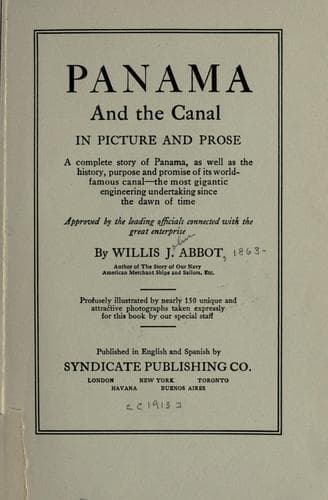
Panama and the Canal in Picture and ProseAbbot, Willis J. (Willis John)
History
Panama and the Canal in Picture and Prose
Abbot, Willis J. (Willis John)
Panama Canal (Panama) -- History
[Illustration: FLUVIOGRAPH AT BOHIO, NOW SUBMERGED]
[Illustration: AUTOMATIC FLUVIOGRAPH ON GATUN LAKE]
Every land comes to be judged largely by its rivers. Speak of Egypt and
you think of the Nile; India suggests the Ganges; England the Thames;
and France the Seine. The Chagres is as truly Panamanian as the Rhine is
German and there have been watches on the Chagres, too, when buccaneers
and revolutionists urged their cayucas along its tortuous highway. It
was the highway by which the despoilers of Peru carried their loot to
the Atlantic on the way to Spain, and along its tide drifted the later
argonauts who sought the golden fleece in California in the days of ’49.
The poet too has sung it, but not in words of praise. Listen to its most
famous lyric from the pen of James Henry Gilbert, Panama’s most famous
bard and most cruel critic.
“Beyond the Chagres River
Are the paths that lead to death--
To the fever’s deadly breezes,
To malaria’s poisonous breath!
Beyond the tropic foliage,
Where the alligator waits,
Are the mansions of the Devil--
His original estates.
“Beyond the Chagres River
Are the paths fore’er unknown,
With a spider ’neath each pebble
A scorpion ’neath each stone.
’Tis here the boa-constrictor
His fatal banquet holds,
And to his slimy bosom
His hapless guest enfolds!
“Beyond the Chagres River
’Tis said--the story’s old--
Are paths that lead to mountains
Of purest virgin gold;
But ’tis my firm conviction,
Whatever tales they tell,
That beyond the Chagres River
All paths lead straight to Hell”!
[Illustration: _Photo by Underwood & Underwood_
THE VILLAGE OF BOHIO, NOW SUBMERGED]
A much maligned stream is the River Chagres. Pioneers, pirates,
prospectors and poets have vied with each other in applying the
vocabulary of contumely and abuse to it, and the practitioners of
medicine have attached its name to a peculiarly depressing and virulent
type of tropical fever. But the humble native loves it dearly and his
homes, either villages of from ten to forty family huts, or mere
isolated cabins cling to its shores all the way from Fort Lorenzo to the
head waters far beyond the boundary of the Canal Zone. The native too
has something of an eye for the picturesque. Always his huts are erected
on a bluff of from 15 to 40 feet rise from the river, with the ground
cleared before them to give an unblocked view of the stream. Whether by
accident or because of a real art instinct he is very apt to choose a
point at a bend in the river with a view both up and down the stream.
Possibly however art had less to do with his choice than an instinct of
self-defense, for in the days of Isthmian turbulence, or for that matter
today, the rivers were the chief highways and it was well to be on
guard for hostile forces coming from either direction.
[Illustration: STEPS LEADING TO FLUVIOGRAPH STATION AT ALHAJUELA
Public-domain text, read in full here on John Shaqi.
Reviews
Reviews
No reviews yet
Be the first to share your thoughts on this work.
Elsewhere in the archive
Join the Discussion
Join the discussion
Sign in to leave a comment or review.
Sign InorCreate an account