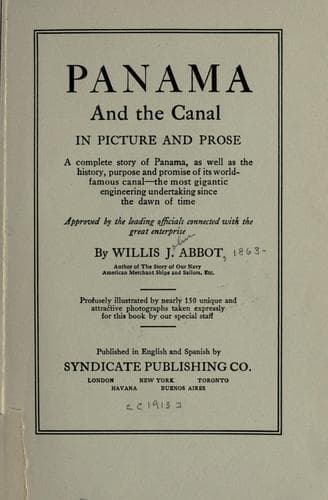
Panama and the Canal in Picture and ProseAbbot, Willis J. (Willis John)
History
Panama and the Canal in Picture and Prose
Abbot, Willis J. (Willis John)
Panama Canal (Panama) -- History
GATUN LAKE AND THE CHAGRES RIVER
That section of the Canal, which for the convenience of engineering
records and directions is known as the Central Division, comprises
within its boundaries two of the great spectacular features of the
Isthmus--Gatun Lake and the Culebra Cut. I have already described the
scenic characteristics of this lake, but some discussion of the part it
plays in the economy of the Canal will not be out of place.
In the first place the creation of the lake depended on the type of
canal to be selected. A sea-level canal could not exist with the lake; a
lock canal could not have been built without it. The meanderings of the
Chagres, crossing and recrossing the only practicable line for the
Canal, and its passionate outbursts in the rainy season made it an
impossible obstacle to a sea-level canal, and all the plans for a canal
of that type contemplated damming the stream at some point above
Gatun--at Bohio, Gamboa or Alhajuela--and diverting its outflow into the
Pacific. On the other hand the lock canal could not be built without
some great reservoir of water to repeatedly fill its locks, and to
supply the waterpower whereby to operate them. Hence Gatun Lake was
essential to the type of canal we adopted.
The lay reader will probably be surprised when he hears how carefully
the area of the Chagres watershed and the average rainfall were studied,
and the height of the dam and the spillway adjusted to make certain a
sufficient supply of water for the locks. The only locks with which
these could be compared are those at the “Soo”, or outlet of Lake
Superior. That canal, the busiest one in the world for eight months in
the year, averaged 39 lockages a day during that period on the American
side and a smaller number through the Canadian locks. The water in Gatun
Lake will be sufficient for 41 passages, if the full length of the locks
is used or 58 if only the partial length is used, which will be the case
with steamships of less than 15,000 tons--and in ships of this class the
bulk of the world’s trade is conducted. If the limit of 41 lockages
seems low, it must be remembered that time is quite as much a factor in
the case as is the water supply. It will take an hour and a half to put
a ship through the locks. That time therefore technically constitutes a
“passage”. In the 24 hours there would be 36 passages possible, and
under the circumstances that would draw most heavily on the lake there
will be water enough for 41.
[Illustration: THE CHAGRES, SHOWING OBSERVER’S CAR
From the swinging car the observer measures the crest of the flood and
rapidity of the current]
For the creation of this lake our engineers found the Chagres River
available. It had dug the valley in which would be stored the vast
volume of water needed, and the unfailing flow from its broad watershed
could be relied upon at all seasons--though indeed in the rainy season
its contribution is sometimes embarrassingly lavish.
Public-domain text, read in full here on John Shaqi.
Reviews
Reviews
No reviews yet
Be the first to share your thoughts on this work.
Elsewhere in the archive
Join the Discussion
Join the discussion
Sign in to leave a comment or review.
Sign InorCreate an account