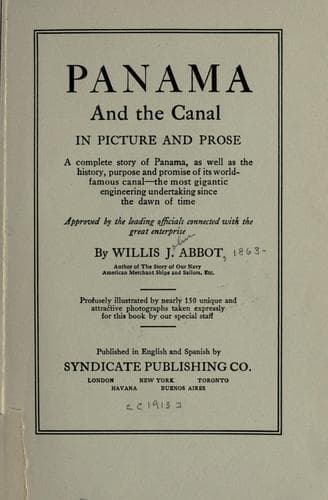
Panama and the Canal in Picture and ProseAbbot, Willis J. (Willis John)
History
Panama and the Canal in Picture and Prose
Abbot, Willis J. (Willis John)
Panama Canal (Panama) -- History
The native craft by which alone the Chagres could be navigated prior to
the creation of the lake are long, slender canoes fashioned usually from
the trunks of the espevé tree, hollowed out by fire and shaped within
and without with the indispensable machete. It is said that occasionally
one is hewn from a mahogany log, for the native has little idea of the
comparative value of the different kinds of timber. Mahogany and
rosewood logs worth thousands of dollars in New York are doing humble
service in native huts in Panama. But the native has a very clear
understanding of the comparative labor involved in hewing out a hardwood
log, and the cayucas are therefore mainly of the softer espevé, a
compact wood with but little grain which does not crack or splinter when
dragged roughly over the rocks of the innumerable rapids. The river
cayuca is about 25 feet along with an extreme beam of about 2¹⁄₂ feet
and a draft of 6 to 10 inches. Naturally it is crank and can tip a white
man into the stream with singular celerity, usually righting itself and
speeding swiftly away with the rushing current. But the natives tread it
as confidently as though it were a scow. For upstream propulsion long
poles are used, there being usually two men to a boat, though one man
standing in the stern of a 30-foot loaded cayuca and thrusting it
merrily up stream, through rocky rapids and swirling whirlpools is no
uncommon sight.
[Illustration: _Photo by Underwood & Underwood_
THE RIVERSIDE MARKET AT MATACHIN]
Our craft was longer--35 feet in all, and in the official service of the
Canal commission had risen to the dignity of a coat of green paint
besides having a captain and a crew of two men. Our captain, though but
in his nineteenth year, was a person of some dignity, conveying his
orders to the crew in tones of command, though not averse to joining in
the lively badinage with which they greeted passing boatmen, or rallied
maidens, washing linen in the streams, upon their slightly concealed
charms. The corrupt Spanish they spoke made it difficult to do more than
catch the general import of these playful interchanges. Curiously enough
the native peasant has no desire to learn English, and frequently
conceals that accomplishment, if he has attained it, as though it were a
thing of which to be ashamed. This attitude is the more perplexing in
view of the fact that the commission pays more to English speaking
natives.
“This boy Manuel”, said my host to me in low tones, “understands English
and can speak it after a fashion, but rarely does so. I entrapped him
once in a brief conversation and said to him, ‘Manuel, why don’t you
speak English and get on the roll of English speaking employees? You are
getting $62.50 gold a month now; then you’d get $75 at least’.
“Manuel dropped his English at once. ‘No quiero aprender a hablar
ingles’, said he, ‘Para mi basta el español’”. (I don’t care. Spanish
good enough for me.)
[Illustration: RAILROAD BRIDGE OVER THE CHAGRES AT GAMBOA
Public-domain text, read in full here on John Shaqi.
Reviews
Reviews
No reviews yet
Be the first to share your thoughts on this work.
Elsewhere in the archive
Join the Discussion
Join the discussion
Sign in to leave a comment or review.
Sign InorCreate an account