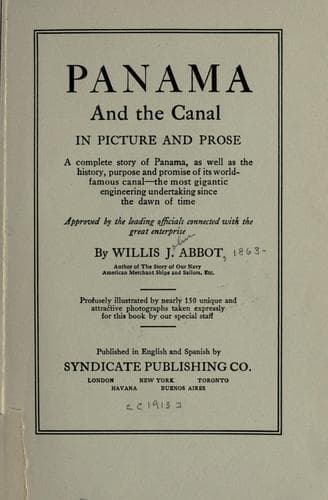
Panama and the Canal in Picture and ProseAbbot, Willis J. (Willis John)
History
Panama and the Canal in Picture and Prose
Abbot, Willis J. (Willis John)
Panama Canal (Panama) -- History
The anchors were removed to some safe
spot and in due time will form part of the historic decorations of the
new city of Balboa.
[Illustration: _Photo by Underwood & Underwood_
WATER GATES IN LOCK WALL
Through these gates the water is admitted to the great conduit in the
center wall of the lock]
[Illustration: _Photo by Underwood & Underwood_
THE LAKE ABOVE GATUN]
Doubtless by the standards of these days the wealth that was carried
back and forth along the Royal Road by men crushed low like termite ants
beneath their heavy burdens, was not great. Yet one gets some idea of
the volume of the trade from Bancroft’s statement that in the year 1624,
just four years after the landing of the Mayflower, goods to the amount
of 1,446,346 pesos d’oro (practically an equal number of dollars), were
registered at the Casa, or custom house, while probably 7¹⁄₂ millions of
dollars’ worth of goods were smuggled through. There were great
warehouses then and a stone church with a neighboring monastery to which
it was customary to send the children of the richer people at Nombre de
Dios to be kept until they had attained their seventh year. For that
piously named town was almost a plague spot and its miasmatic
atmosphere was fatal to tender infants.
The paved trail echoes no more with the muleteer’s cry, or the clatter
of hoofs, nor are there wine shops to tempt the traveler, for there are
none to be tempted. But even in its palmiest days Cruces could have been
but a dismal spot. Gage, a soldier of fortune and an itinerant preacher,
visited the village in 1638 and left us this record:
“Before ten of the clock we got to Venta de Cruces where lived none but
mulattoes and blackmores who belong unto the flat boates that
merchandize to Portobel. There I had much good entertainment by the
people who desired me to preach unto them the next Sabbath day and gave
me twenty crownes for my sermon and procession. After five days of my
abode there, the boats set out, which were much stopped in their passage
down the river, for in some places we found the water very low, so that
the boats ran upon the gravel; from whence with poles and the strength
of the blackmores they were to be lifted off again”.
After the lapse of almost four centuries we found the shallows still
there and the blackmores--or their descendants--ready to carry our boat
past their fall. But the people who paid the early traveler twenty
crowns for a sermon had vanished as irrevocably as the city’s public
edifices, and no descendants of like piety remain. Morgan’s fierce
raiders swept through the village in 1670, and its downfall may have
begun then, for the stout Protestantism of the buccaneers manifested
itself in burning Catholic churches and monasteries in intervals of the
less pious, but more pleasing, occupation of robbing the Spaniards or
torturing them to extort confessions of the hiding places of their
wealth.
[Illustration: HOW THEY GATHER AT THE RIVER]
Public-domain text, read in full here on John Shaqi.
Reviews
Reviews
No reviews yet
Be the first to share your thoughts on this work.
Elsewhere in the archive
Join the Discussion
Join the discussion
Sign in to leave a comment or review.
Sign InorCreate an account