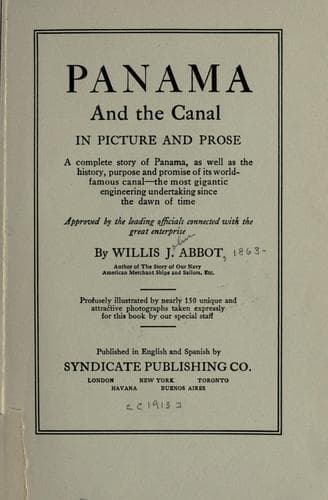
Panama and the Canal in Picture and ProseAbbot, Willis J. (Willis John)
History
Panama and the Canal in Picture and Prose
Abbot, Willis J. (Willis John)
Panama Canal (Panama) -- History
In the matter of conserving the waters of the Chagres, estimating the
total capacity of the watershed and in providing for swift forwarding of
information concerning sudden rises we shall always be under great
obligations to the French. Their hydrographic observations and records
are invaluable, and their stations established before we assumed control
are still used, with much of their machinery. Stations are maintained
far up the valleys of the Chagres and tributary rivulets, and all are
connected with the central control at Gatun dam by telephone. Some of
the stations are equipped with automatic machinery which, in the event
of a rise during the night summons the keeper by ringing an alarm bell.
The life of the keeper of a fluviograph station, miles perhaps of jungle
isolating him from the nearest human habitation, is lonesome enough. Yet
its monotony is sometimes relieved by lively incident. The irascible
Chagres, for example, once caught the keeper at Alhajuela with a sudden
rise, and compelled him to camp out a night and day in a tree top and
see his house, pigs and poultry swept away on the rushing tide. There
was a fair chance that the tree would follow.
[Illustration: POLING UP THE RAPIDS]
[Illustration: _Photo by S. H. Elliott_
CONSTRUCTION WORK ON THE SPILLWAY]
On our way up the river to visit some of the fluviographs we landed at
Cruces, went a brief space into the jungle and cleared away with
machetes the tangled vegetation until the old trail, or Royal Road to
Panama, was laid bare. Three to four feet wide or thereabouts it was,
and at points rudely paved with cobble stones. The nature and dimensions
of the trail show that it was not intended for wheeled carriages, and
indeed a native vehicle is a rarity on the Isthmus today, except in the
towns. Time came when with the growing power and cruelty of the
Spaniards this Camina Reale, or King’s Highway, was watered with the
blood of Indian slaves, bearing often their own possessions stolen from
them by the Spaniard who plied on their bent backs his bloody lash. It
may have been over this trail that Balboa carried, with incredible
labor, the frames of three ships or caravels, which he afterwards
erected and launched in the Pacific. Several years ago there were found
in the jungle near Cruces two heavy anchors, with 14-foot shafts and
weighing about 600 pounds which had been carried thus far on the way to
the Pacific and there dropped and left to the kindly burial of the
tropical jungle. When they were discovered a too loyal graduate of our
military academy at West Point in charge of some engineering work on the
Isthmus, thought it would be a fine thing to send them up there and have
them preserved on the parade ground of the academy. Without announcing
his intention he had them removed from the spot where they were found
and had taken them as far as the steamship wharf at Colon when Col.
Goethals--who has a habit of hearing of things that are not
announced--quietly interfered.
Public-domain text, read in full here on John Shaqi.
Reviews
Reviews
No reviews yet
Be the first to share your thoughts on this work.
Elsewhere in the archive
Join the Discussion
Join the discussion
Sign in to leave a comment or review.
Sign InorCreate an account