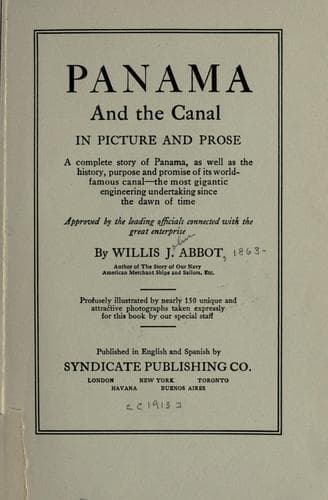
Panama and the Canal in Picture and ProseAbbot, Willis J. (Willis John)
History
Panama and the Canal in Picture and Prose
Abbot, Willis J. (Willis John)
Panama Canal (Panama) -- History
squarely on his head killing him instantly, but was sufficiently
deflected by the hardness of the Ethiopian skull to miss the box on
which the victim sat. Had it been otherwise the neighboring landscape
and its population would have been materially changed.
[Illustration: ONE OF THE COLONEL’S TROUBLES
This shovel was overwhelmed by a slide. The accident is not uncommon]
[Illustration: _Photo by Underwood & Underwood_
THE SLICED-OFF HILL AT ANCON]
It is no wonder that we have trains to dodge during the course of our
stroll. There are at the moment of our visit 115 locomotives and 2000
cars in service in the Cut. About 160 loaded trains go out daily, and,
of course about 160 return empty. Three hundred and twenty trains in the
eight-hour day, with two hours’ intermission at noon, means almost one
train a minute speeding through a right of way 300 feet wide and much
cluttered up with shovels, drills and other machinery. In March, 1911,
the record month, these trains handled 1,728,748 cubic yards of
material, carrying all to the dumps which average 12 miles distant, the
farthest one being 33 miles. The lay mind does not at first think of
it, but it is a fact that it was no easy task to select spots for all
this refuse in a territory only 436 square miles in area, of which 164
square miles is covered by Gatun Lake and much of the rest is higher
than the Cut and therefore unsuited for dumps. The amount of material
disposed of would create new land worth untold millions could it have
been dumped along the lake front of Chicago, or in the Hackensack
meadows near New York.
[Illustration: _Photo by S. H. Elliott_
A LOCK-CHAMBER FROM ABOVE]
To load these busy trains there were in the Cut in its busiest days 43
steam shovels mainly of the type that would take five cubic yards of
material at a bite. One load for each of these shovels weighed 8.7 tons
of rock, 6.7 tons of earth, or 8.03 tons of the “run of the Cut”--the
mixed candy of the Culebra shop. March 11, 1911, was the record day for
work on the Central Division of which the Cut is the largest component
part. That day 333 loaded trains were run out and as many in, and 51
steam shovels and 2 cranes with orange peel buckets excavated 127,742
tons of material. It was no day for nervous tourists to go sightseeing
in the Cut.
[Illustration: WHEN THE OBISPO BROKE IN]
Public-domain text, read in full here on John Shaqi.
Reviews
Reviews
No reviews yet
Be the first to share your thoughts on this work.
Elsewhere in the archive
Join the Discussion
Join the discussion
Sign in to leave a comment or review.
Sign InorCreate an account