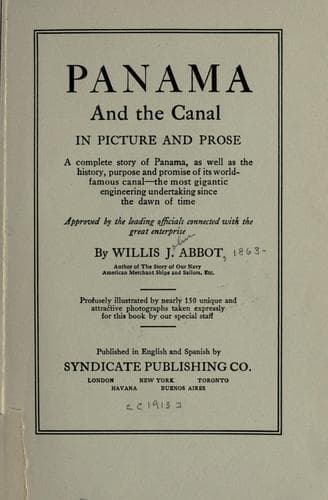
Panama and the Canal in Picture and ProseAbbot, Willis J. (Willis John)
History
Panama and the Canal in Picture and Prose
Abbot, Willis J. (Willis John)
Panama Canal (Panama) -- History
Perhaps the most impressive view of the Cut in the days of its activity
was that from above. It was the one which gave the broadest general
sense of the prodigious proportions of the work. But a more terrifying
one, as well as a more precise comprehension of the infinity of detail
coupled with the magnitude of scope of the work was to be obtained by
plodding on foot through the five miles where the battle of Culebra was
being most fiercely fought. The powers that be--or that were--did not
encourage this method of observation. They preferred to send visitors
through this Death’s Lane, this confusing network of busy tracks, in an
observation car built for the purpose, or in one of the trim little
motor cars built to run on the railroad tracks for the use of officials.
From the fact that one of the latter bore the somewhat significant
nickname “The Yellow Peril” and from stories of accidents which had
occurred to occupants of these little scouts among the mighty engines of
war, I am inclined to think that the journey on foot, if more wearisome,
was not more perilous.
[Illustration: THE TRACK SHIFTER IN ACTION]
Put on then a suit of khaki with stout shoes and take the train for
Culebra. That will be as good a spot as any to descend into the Cut, and
we will find there some airy rows of perpendicular ladders connecting
the various levels up and down which an agile monkey, or Col. Gaillard
or any of his assistants, can run with ease, but which we descend with
infinite caution and some measure of nervous apprehension. Probably the
first sound that will greet your ears above the general clatter, when
you have attained the floor of the Canal will be a stentorian cry of
“Look out, there! Look out”! You will hear that warning hail many a time
and oft in the forenoon’s walk we are about to take. I don’t know of any
spot where Edward Everett Hale’s motto, “Look Out and Not In; Look Up
and Not Down; Look Forward and Not Back” needs editing more than at
Culebra. The wise man looked all those ways and then some. For trains
are bearing down upon you from all directions and so close are the
tracks and so numerous the switches that it is impossible to tell the
zone of safety except by observing the trains themselves. If your gaze
is too intently fixed on one point a warning cry may call your attention
to the arm of a steam shovel above your head with a five-ton boulder
insecurely balanced, or a big, black Jamaican a few yards ahead
perfunctorily waving a red flag in token that a “dobe” blast is to be
fired. A “dobe” blast is regarded with contempt by the fellows who
explode a few tons of dynamite at a time and demolish a whole hillside,
but the “dobes” throw fifty to one hundred pound stones about in a
reckless way that compels unprofessional respect. They tell a story on
the Zone of a negro who, not thinking himself in range, was sitting on a
box of dynamite calmly smoking a cigarette. A heavy stone dropped
Public-domain text, read in full here on John Shaqi.
Reviews
Reviews
No reviews yet
Be the first to share your thoughts on this work.
Elsewhere in the archive
Join the Discussion
Join the discussion
Sign in to leave a comment or review.
Sign InorCreate an account