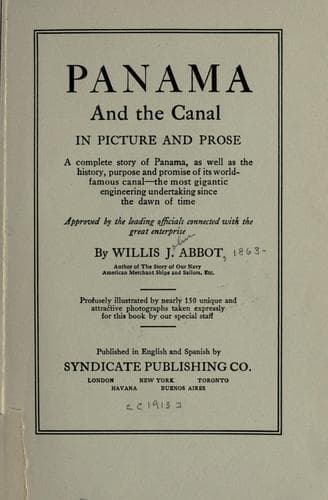
Panama and the Canal in Picture and Prose — John Shaqi
Panama and the Canal in Picture and ProseAbbot, Willis J. (Willis John)
History
Panama and the Canal in Picture and Prose
Abbot, Willis J. (Willis John)
Panama Canal (Panama) -- History
If that country alone is happy whose history is uninteresting, then
sorrow must have been the ordained lot of Panama. Visited first by
Columbus in 1502, at which time the great navigator put forth every
effort to find a strait leading through to the East Indies, it has
figured largely in the pages of history ever since. Considerable cities
of Spanish foundation rose there while our own Jamestown and Plymouth
were still unimagined. The Spaniards were building massive walls,
erecting masonry churches, and paving royal roads down there in the
jungle long before the palisades and log huts of Plymouth rose on the
sandy shores of Cape Cod Bay. If the ruins of the first city of Panama,
draped with tropical vines, are all that remain of that once royal city,
its successor founded in 1673 still stands with parts of the original
walls sturdily resisting the onslaught of time.
It appears there are certain advantages about geographical littleness.
If Panama had been big the eyes of the world would never have been
fastened upon it. Instinctively Columbus sought in each of its bays,
opening from the Caribbean that strait which should lead to far Cathay.
Seeking the same mythical passage Balboa there climbed a hill where
“--with eagle eyes,
He star’d at the Pacific--and all his men
Look’d at each other with a wild surmise
Silent upon a peak in Darien.”
Hope of a natural strait abandoned, the narrowness of the Isthmus made
it the shortest route for Cortez, Pizarro and other famous Spanish
robbers and murderers to follow in their quest for the gold of the
Incas. As the Spaniards spoiled Peru, so the buccaneers and other
pirates, belonging to foreign nations, robbed and murdered the
Spaniards. The gold fever filled the narrow Isthmus full of graves, and
of moldering bodies for which there was not even hasty sepulture. In
time the Peruvian hoards were exhausted, Spaniards and Englishmen,
buccaneers and pirates vanished. Then came a new invasion--this time by
a nation unknown in the days of the Great Trade and the Royal Road. Gold
had been discovered in California, and now troops of Americans fought
their way through the jungle, and breasted the rapids of the Chagres
River. They sought gold as had Pizarro and Cortez, but they sought it
with spade and pan, not with sword and musket. In their wake came the
Panama Railroad, a true pioneer of international trade. Then sprung up
once more the demand for the waterway across the neck which Columbus had
sought in vain.
Public-domain text, read in full here on John Shaqi.
Reviews
Reviews
No reviews yet
Be the first to share your thoughts on this work.
Join the Discussion
Join the discussion
Sign in to leave a comment or review.
Sign InorCreate an account