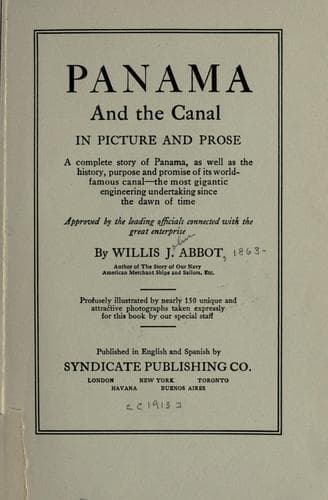
Panama and the Canal in Picture and ProseAbbot, Willis J. (Willis John)
History
Panama and the Canal in Picture and Prose
Abbot, Willis J. (Willis John)
Panama Canal (Panama) -- History
It seemed to me, as the result of questioning and observation rather
than by any personal experience, that living expenses in Panama City
must be high, and good living according to our North American ideas
impossible. What the visitor finds in the homes of the people on the
Canal Zone offers no guide to the conditions existing in the native
town. For the Zone dwellers have the commissary to buy from, and that
draws from all the markets of the world, and is particularly efficient
in buying meats, which it gets from our own Beef Trust and sells for
about half of what the market man in Chicago or New York exacts. But the
native Panamanian has no such source of supply. His meats are mainly
native animals fresh killed, and if you have a taste for sanguinary
sights you may see at early dawn every morning numbers of cattle and
hogs slaughtered in a trim and cleanly open air abattoir which the
Panamanians owe to the Canal authorities. However the climate tends to
encourage a fish and vegetable diet, and the supplies of these staples
are fairly good. The family buying is done at a central market which it
is well worth the tourists’ time to visit.
[Illustration: _Photo by Gause_
THE FISH MARKET]
Every day is market day at Panama, but the crowded little open-air mart
is seen at its best of a Saturday or Sunday in the early morning. All
night long the native boats, mostly cayucas hewn out of a single log and
often as much as 35 feet long, and with a schooner rig, have been
drifting in, propelled by the never-failing trade wind. They come from
the Bayano River country, from Chorrera, from Taboga and the Isles of
Pearls, from the Bay of San Miguel and from the land of the San Blas
Indians. Great sailors these latter, veritable vikings of the tropics,
driving their cayucas through shrieking gales when the ocean steamers
find it prudent to stay in port.
[Illustration: SAN BLAS BOATS AT THE MARKET PLACE]
Nature helps the primitive people of the jungle to bring their goods to
the waiting purchasers. The breeze is constant, seldom growing to a
gale, and the tide rising full 20 feet enables them to run their boats
at high tide close to the market causeway, and when the tide retires
land their products over the flats without the trouble of lighterage.
True the bottom is of mud and stones, but the soles of the seamen are
not tender, nor are they squeamish as to the nature of the soil on which
they tread.
[Illustration: _Photo by Gause_
THE VEGETABLE MARKET]
Public-domain text, read in full here on John Shaqi.
Reviews
Reviews
No reviews yet
Be the first to share your thoughts on this work.
Elsewhere in the archive
Join the Discussion
Join the discussion
Sign in to leave a comment or review.
Sign InorCreate an account