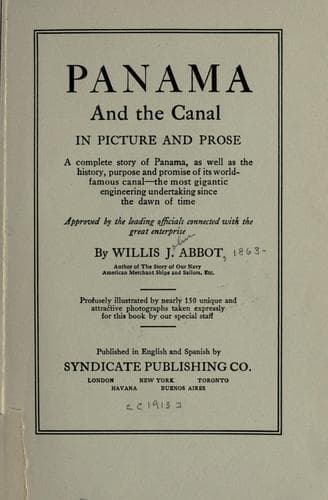
Panama and the Canal in Picture and ProseAbbot, Willis J. (Willis John)
History
Panama and the Canal in Picture and Prose
Abbot, Willis J. (Willis John)
Panama Canal (Panama) -- History
The market is open at dawn, and the buyers are there almost as soon as
the sellers, for early rising is the rule in the tropics. Along the
sidewalks, on the curbs, in the muddy roadway even, the diverse fruits
and food products of the country are spread forth to tempt the robust
appetites of those gathered about. Here is an Indian woman, the color of
a cocoanut, and crinkled as to skin like a piece of Chinese crepe.
Before her is spread out her stock, diverse and in some items curious.
Green peppers, tomatoes a little larger than a small plum, a cheese
made of goat’s milk and packed to about the consistency of Brie; a few
yams, peas, limes and a papaya or two are the more familiar edibles.
Something shaped like a banana and wrapped in corn husks arouses my
curiosity.
[Illustration: THE MARKET ON THE CURB]
[Illustration: WHERE THE FLIES GET BUSY]
“What is it”? “Five cents”. “No, no! I mean what is it? What’s it made
of”? “Fi centavo”!
In despair over my lack of Indo-Spanish patois, I buy it and find a
little native sugar, very moist and very dark, made up like a sausage,
or a tamale in corn husks. Other mysterious objects turn out to be
ginseng, which appeals to the resident Chinese; the mamei, a curious
pulpy fruit the size of a large peach, with a skin like chamois and a
fleshly looking pit about the size of a peach-stone; the sapodilla, a
plum colored fruit with a mushy interior, which when cut transversely
shows a star-like marking and is sometimes called the star apple. It is
eaten with a spoon and is palatable. The mamei, however, like the mango,
requires a specially trained taste.
[Illustration: CAYUCAS ON MARKET DAY]
While puzzling over the native fruits a sudden clamor attracts us to a
different part of the market. There drama is in full enactment. The
market place is at the edge of the bay and up the water steps three
exultant fishermen have dragged a tuna about five feet long, weighing
perhaps 175 pounds. It is not a particularly large fish of the species,
but its captors are highly exultant and one, with the inborn instinct of
the Latin-American to insult a captive or a fallen foe, stands on the
poor tuna’s head and strikes an attitude as one who invites admiration
and applause. Perhaps our camera tempted him, but our inclination was to
kick the brute, rather than to perpetuate his pose, for the poor fish
was still living. It had been caught in a net, so its captors informed
us. On our own Florida and California coasts the tunas give rare sport
with a rod and line.
Public-domain text, read in full here on John Shaqi.
Reviews
Reviews
No reviews yet
Be the first to share your thoughts on this work.
Elsewhere in the archive
Join the Discussion
Join the discussion
Sign in to leave a comment or review.
Sign InorCreate an account