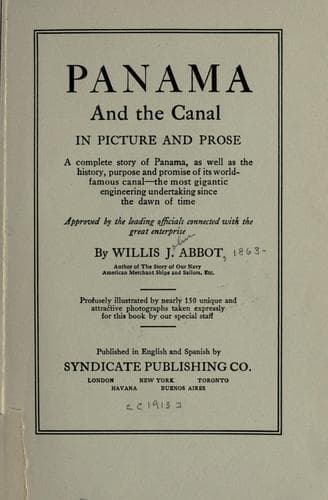
Panama and the Canal in Picture and ProseAbbot, Willis J. (Willis John)
History
Panama and the Canal in Picture and Prose
Abbot, Willis J. (Willis John)
Panama Canal (Panama) -- History
Like most people of a low order of intelligence the lower class native
of Panama is without the slightest sense of humanity to dumb animals. He
does not seem to be intentionally cruel--indeed he is too indolent to
exert himself unless something is to be gained. But he never lets any
consideration for the sufferings of an animal affect his method of
treating it. The iguana, ugliest of lizards, which he eats with avidity,
is one of his chief victims. This animal is usually taken alive by
hunters in order that he may undergo a preliminary fattening process
before being committed to the pot. In captivity his condition is not
pleasant to contemplate. Here at the market are eight or ten, living,
palpitating, looking out on the strange world with eyes of wistful
misery. Their short legs are roughly twisted so as to cross above their
backs, and the sharp claws on one foot are thrust through the fleshy
part of the other so as to hold them together without other fastening. A
five-foot iguana is fully three feet tail, and of that caudal yard at
least two feet of its tapering length is useless for food, so the native
calmly chops it off with his machete, exposing the mutilated but living
animal for sale.
[Illustration: _Photo by Underwood & Underwood_
PANAMA FROM THE BAY; ANCON HILL IN THE BACKGROUND]
To our northern eyes there is probably no animal except a serpent more
repulsive than the iguana. He is not only a lizard, but a peculiarly
hideous one--horned, spined, mottled and warty like a toad. But
loathsome as he is, the wanton, thoughtless tortures inflicted upon him
by the marketmen invest him with the pathetic dignity which martyrs
bear.
Fish is apparently the great staple of the Panama market, as beseems a
place which is practically an island and the very name of which
signifies “many fishes”. Yet at the time I was there the variety exposed
for sale was not great. The corbina, apparently about as staple and
certain a crop as our northern cod, the red snapper, mullet and a flat
fish resembling our fresh water sunfish, were all that were exhibited.
There were a few West Indian lobsters too, about as large as our average
sized lobsters, but without claws, having antennae, perhaps 18 inches
long, instead. Shrimps and small molluscs were plentifully displayed. As
to meats the market was neither varied nor pleasing. If the assiduous
attentions of flies produce any effect on raw meats prejudicial to human
health, the Panama market offers rich field for some extension of the
sanitary powers of Col. Gorgas.
[Illustration: Copyright, 1913, F. E. Wright.
AVENIDA B. PANAMA CITY
Most of the streets in Panama end at the water side as the city is built
upon a narrow promontory. The effect of the blue water and sky closing
the end of the narrow street of parti-colored houses is picturesque.]
Public-domain text, read in full here on John Shaqi.
Reviews
Reviews
No reviews yet
Be the first to share your thoughts on this work.
Elsewhere in the archive
Join the Discussion
Join the discussion
Sign in to leave a comment or review.
Sign InorCreate an account