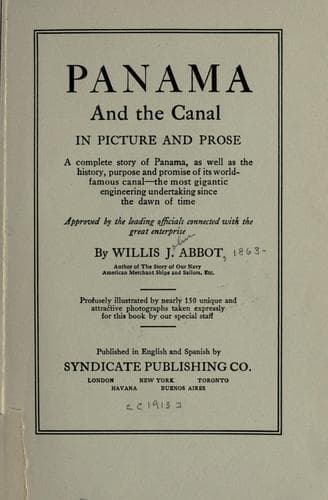
Panama and the Canal in Picture and ProseAbbot, Willis J. (Willis John)
History
Panama and the Canal in Picture and Prose
Abbot, Willis J. (Willis John)
Panama Canal (Panama) -- History
This smoldering wrath is ever ready to break out; the brutal savagery
which manifests itself in the recurrent revolutions of Spanish-America
is ever present in Panama. On the Fourth of July, 1912, the Americans
resident on the Zone held patriotic exercises at Ancon. After the
speeches and the lunch a number of the United States marines wandered
into the City of Panama and, after the unfortunate fashion of their
kind, sought out that red-lighted district of infamy which the Panama
authorities have thoughtfully segregated in a space between the public
hospital and the cemeteries. The men were unarmed, but in uniform.
Naturally their holiday began by visits to a number of Panamanian gin
mills where the liquid fuel for a fight was taken aboard. In due time
the fight came. A Panama policeman intervened and was beaten for his
pains. Other police came to his rescue. Somebody fired a shot and soon
the police, running to their station, returned with magazine rifles and
began pumping bullets into the unarmed marines. The latter for a time
responded with stones, but the odds were too great and they broke and
ran for the American territory of the Canal Zone. Meantime of course the
noise of the fusillade had alarmed the American authorities. At Ancon,
separated from Panama City only by an imaginary boundary line, the Zone
police were mustered for service in case of need, and at Camp Otis, an
hour away by rail, the 10th Infantry, U. S. A., was drawn up under arms,
and trains made ready to bring the troops to the riotous city at
command. But the order never came, though the 10th officers and men
alike were eager for it. It could come only through the American
minister, and he was silent, believing that the occasion did not warrant
the employment of the troops on the foreign soil of Panama. So the
marines--or as many of them as their officers could gather up--were sent
to their post, Camp Elliott, by train while those arrested by the
Panamanians were taken to the Chiriqui Jail, or to the Panama hospitals.
In jail the unarmed captives were beaten and tortured after the fashion
of the average Latin-American when he has a foe, helpless in his power.
The day ended with three American marines killed and many wounded; the
Americans, soldiers and civilians, both gritting their teeth and eager
to take possession of Panama; and the Panamanians, noisy, insolent,
boastful, bragging of how they had whipped the “Yankee pigs” and daring
the whole United States to attempt any punishment.
[Illustration: TABOGA, THE PLEASURE PLACE OF PANAMA]
The United States seems to have supinely “taken the dare”, as the boys
would say, for though the affray and the murders occurred in July, 1912,
nothing has yet been done. In answer to a formal query in April, 1913,
the Department of State replied that the matter was “still the subject
of diplomatic correspondence which it is hoped will have a satisfactory
termination”.
Public-domain text, read in full here on John Shaqi.
Reviews
Reviews
No reviews yet
Be the first to share your thoughts on this work.
Elsewhere in the archive
Join the Discussion
Join the discussion
Sign in to leave a comment or review.
Sign InorCreate an account