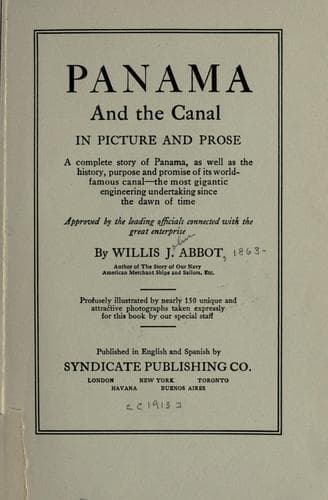
Panama and the Canal in Picture and ProseAbbot, Willis J. (Willis John)
History
Panama and the Canal in Picture and Prose
Abbot, Willis J. (Willis John)
Panama Canal (Panama) -- History
Americans on the Zone are depressed over the seeming lack of vigor on
the part of the home government. They say that the apparent immunity
enjoyed by the assailants of the marines has only enhanced the
contemptuous hatred of the natives for the Americans. “Let them step on
our side of the line”, says the swashbuckling native with a chip on his
shoulder, “and we’ll show ’em”. Among the Americans on the Zone there is
almost universal regret that the troops were not marched into Panama on
the day of the riot. Authority existed under the treaty with the
Republic of Panama. The troops were ready. The lesson need not have been
a severe one, but it was deserved and would have been lasting.
Furthermore those best equipped to judge say that the event is only
deferred, not averted. “Spiggotty” and “Gringo” will not continue long
to make faces over an imaginary line without a clash.
[Illustration: SANTA ANA CHURCH, 1764]
Despite the feeling against the Americans, all classes of Panamanians
must admit receiving a certain amount of advantage from the activities
of the Canal builders. Moreover the $10,000,000 paid over by the United
States for the Canal Zone has not been squandered, nor has it been
dissipated in graft. We are inclined to laugh because one of the first
uses to which it was put was to build a government theater, which is
opened scarce thirty days out of the year. But it is fair to take the
Latin temperament into consideration. There is no Latin-American
republic so impoverished as not to have a theater built by the public.
The Republic of Panama, created overnight, found itself without any
public buildings whatsoever, barring the jail. Obviously a national
capitol was the first need and it was speedily supplied. If one wing was
used to house a theater that was a matter for local consideration and
not one for cold-blooded Yankees to jeer about. The Republic itself was
a little theatrical, rather reminiscent of the papier-mâché creations of
the stage carpenter, and might be expected to vanish like a
transformation scene. At any rate with the money in hand the Panamanians
built a very creditable government building, including a National
Theater, and an imposing building for the National Institute as well.
They might have done worse. It showed that the revolution was more of a
business affair than most Central-American enterprises of that sort. The
average leader of so successful an enterprise would have concealed the
greater part of the booty in a Paris bank account to his own order, and
used the rest in building up an army for his own maintenance in power.
Panama has her needed public buildings--let us wink at the theater--and
$7,500,000 invested in New York against a time of need.
[Illustration: _Photo by Underwood & Underwood_
THE PANAMA NATIONAL INSTITUTE
In the background is the Canal administration building and the residence
of Col. Gorgas]
Public-domain text, read in full here on John Shaqi.
Reviews
Reviews
No reviews yet
Be the first to share your thoughts on this work.
Elsewhere in the archive
Join the Discussion
Join the discussion
Sign in to leave a comment or review.
Sign InorCreate an account