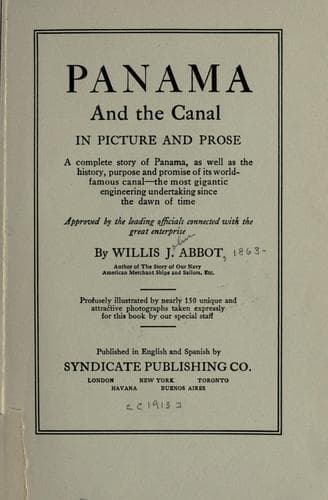
Panama and the Canal in Picture and ProseAbbot, Willis J. (Willis John)
History
Panama and the Canal in Picture and Prose
Abbot, Willis J. (Willis John)
Panama Canal (Panama) -- History
The three government buildings in the City of Panama are all creditable
architecturally, and from a superficial standpoint structurally as well.
Whenever you are shown a piece of government work in a Latin-American
country your guide always whispers “graft”--as for that matter is the
practice in New York as well. But Panama seems to have received the
worth of its money. The Government Palace, which corresponds to our
national capitol, stands facing a little plaza open toward the sea. It
is nearly square, 180 by 150 feet, surrounding a tasteful court or patio
after the South American manner. Built of rubble masonry it is faced
with white cement, and is of a singularly simple and effective
architectural style for a Latin-American edifice. The building houses
the Assembly Hall, the Government Theater and the public offices. The
interior of the theater, which seats about 1000, is rather in the
European than the North American style with a full tier of boxes, large
foyers decorated with paintings by Panama artists, and all the
appurtenances of a well-appointed opera house.
[Illustration: THE MUNICIPAL BUILDING]
[Illustration: THE NATIONAL PALACE AND THEATER]
Next to the Government Palace the most ambitious public building in
Panama is the home of the National Institute, or University, which
nestles at the foot of Ancon Hill. This is a group of seven buildings
surrounding a central court. The Institute is designed in time to become
a true university, but its accommodations are at present far in advance
of its needs. Equipped with an excellent faculty it will for some time
to come--it was opened only in 1911--suffer from a lack of pupils,
because the public schools in the Republic are not yet fitted to equip
pupils for a university course. The population of Panama is largely
illiterate. The census in 1911 showed 60,491 children of school age, and
only 18,607 enrolled in schools of all classes. Of those more than
16,000 were enrolled in the primary schools. The Government however is
doing all it can to encourage education among the masses, and the
National Institute will offer to all who fit themselves to enter its
classes not only free tuition, but free board and lodging as well.
The third considerable public building in Panama is the Municipal
Building which stands at one corner of the Cathedral Plaza. It contains,
beside the council chamber and usual offices, the Columbus Library of
about 2500 books, including many rare volumes on the ancient history of
the Isthmian land and its people.
To return however to the physical aspects of the City of Panama. It is
recorded of a certain King of Spain that when certain bills for the
fortification of Panama City were presented to him he gazed into
vacancy with the rapt eyes of one seeing visions.
“Methinks I behold those walls from here”, quoth he to the suppliant
treasurer, “they must be so prodigious”!
[Illustration: _Photo by Gause_
SALIENT ANGLE OF LANDWARD WALL]
Public-domain text, read in full here on John Shaqi.
Reviews
Reviews
No reviews yet
Be the first to share your thoughts on this work.
Elsewhere in the archive
Join the Discussion
Join the discussion
Sign in to leave a comment or review.
Sign InorCreate an account