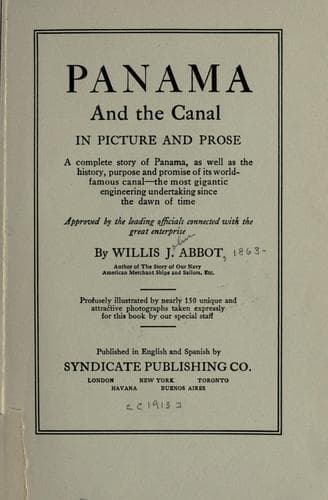
Panama and the Canal in Picture and ProseAbbot, Willis J. (Willis John)
History
Panama and the Canal in Picture and Prose
Abbot, Willis J. (Willis John)
Panama Canal (Panama) -- History
The clause in the treaty which grants to the United States authority to
maintain order in the Republic might very readily be stretched to
include police power over Panama. This has not been done however and the
city has its own police force, an exceedingly numerous one for a town of
its size. Undoubtedly, however, diplomatic representations from the
United States have caused the Panamanians to put their police
regulations somewhat in accord with North American ideas. There are no
more bull fights--“We never had very good bull-fights anyway”, said a
Panama gentleman plaintively acquiescing in this reform. Cock-fights
however flourish and form, with the lottery drawing, the chief Sunday
diversion. A pretty dismal spectacle it is, too, with two attenuated
birds, often covered with blood and half sightless, striking fiercely at
each other with long steel spurs, while a crowd of a hundred or so,
blacks and whites, indiscriminately yell encouragement and shriek for
bets from the surrounding arena. The betting in fact is the real support
of the game. The Jamaicans particularly have their favorite cocks and
will wager a week’s pay on their favorites and all of their wives’
laundry earnings they can lay hands upon as well. One or two gamecocks
tethered by the leg are as common a sight about a Jamaican’s hut as
“houn’ dawgs” around a Missouri cabin.
[Illustration: CHURCH OF OUR LADY OF MERCY (LA MERCED)]
If there is any regulation of the liquor traffic in Panama, it is not
apparent to the casual observer. Nowhere does one see so much drinking,
and nowhere that people drink at all is there less drunkenness. It is a
curious fact that these two phenomena--wide-open drinking places and
little drunkenness--are often found together. In Panama the saloons are
legion, and I regret to say the biggest of them are run by Americans. No
screens obstruct a full view of the interiors, and hardened tipplers
flaunt their vice in the faces of all beholders. Perhaps the very
publicity impels them to quit before they are hopelessly befuddled.
Possibly the moist and somewhat debilitating climate permits the
innocuous use of stimulants to a greater extent than would be possible
in the North. Beside the absence of any scandalous open drunkenness
there seems to be some significance in the fact that the records of the
Zone hospitals show a surprisingly small number of deaths from diseases
induced by chronic alcoholism. But the casual observer strolling on
Avenida Centrale, or along the streets tributary to it, might be excused
for thinking Panama one great grog shop. It is curious, too, that
despite the Latin character of the populace the taste for light wines,
in which some see the hope of national temperance, does not seem
general. Whisky, brandy and rum are the regular tipples. On a still
remembered night in Panama, before the American invasion, the Centrale
Hotel bar was made free to all. No drinks were served to the thirsty,
Public-domain text, read in full here on John Shaqi.
Reviews
Reviews
No reviews yet
Be the first to share your thoughts on this work.
Elsewhere in the archive
Join the Discussion
Join the discussion
Sign in to leave a comment or review.
Sign InorCreate an account