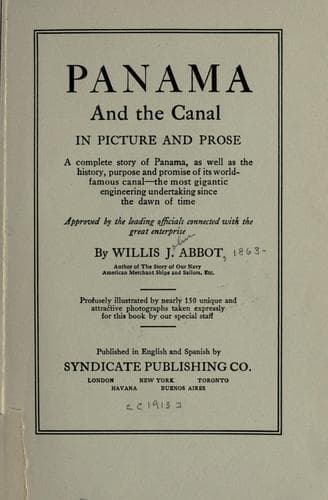
Panama and the Canal in Picture and ProseAbbot, Willis J. (Willis John)
History
Panama and the Canal in Picture and Prose
Abbot, Willis J. (Willis John)
Panama Canal (Panama) -- History
Clubs share with churches in the social life of Panama. Perhaps indeed
they rather outshine the latter. At any rate such buildings as the Union
Club and the University Club, both of which abut upon the bay would be a
credit to a city twice the size. The former club, as its name implies,
was intended to be a meeting place where liberals and conservatives
could lay aside political differences in social unity. However, politics
in Panama, as in all places where there are not real vital issues
dividing the parties, breeds bitter personal feeling and the Union Club
is said to be far from being the home of political unity. It has,
however, an excellent building, with a spacious ball-room, a swimming
tank and a magnificent view of Panama Bay with its picturesque islands.
The University Club is more an American club than a Panamanian, and it
no longer observes the restriction as to membership which its name would
imply. It too has a spacious ball-room and is a social center for the
Zone dwellers who form the major part of its membership.
The Cathedral Plaza is socially the center of town, though
geographically the old French Plaza of Santa Ana is more near the
center. Directly opposite the Cathedral is the Hotel Centrale, built
after the Spanish fashion, with four stories around a central court. In
the blither days of the French régime this court was the scene of a
revelry to which the daily death roll formed a grim contrast. However
the occasional gaiety of the Centrale Patio did not end with the French.
Even in the prosaic Yankee days of the last carnival the intervention of
the police was necessary to prevent a gentleman from being wholly
denuded, and displayed to the revelers in nature’s garb as a specimen of
the superior products of Panama.
[Illustration: _Photo by Underwood & Underwood_
BUST OF LIEUT. NAPOLEON B. WYSE
This bust stands on the sea wall. The picture shows it guarded by a
United States soldier and a Panama policeman]
On a nearby corner of the Plaza is the old French administration
building, afterward occupied by the Isthmian Canal Commission. In 1905
it was a central point of infection for the yellow-fever epidemic, and
though repeatedly fumigated was finally abandoned by the American
engineers who moved their headquarters out to Culebra.
Public-domain text, read in full here on John Shaqi.
Reviews
Reviews
No reviews yet
Be the first to share your thoughts on this work.
Elsewhere in the archive
Join the Discussion
Join the discussion
Sign in to leave a comment or review.
Sign InorCreate an account