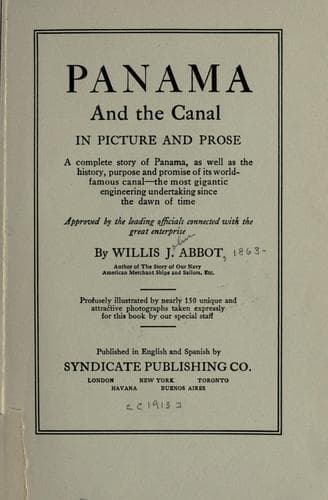
Panama and the Canal in Picture and ProseAbbot, Willis J. (Willis John)
History
Panama and the Canal in Picture and Prose
Abbot, Willis J. (Willis John)
Panama Canal (Panama) -- History
[Illustration: FRENCH VILLAGE OF EMPIRE AFTER CLEANING UP BY AMERICANS]
[Illustration: THE BAY OF TABOGA FROM THE SANITARIUM]
“The campaign against malaria was inaugurated on the following plan: (1)
Treatment with adequate doses of quinine (about 30 grains a day for
adults) of all cases of malaria. First, because this treatment is
curative; and, second, because unless so treated, each case of malaria
constitutes a focus from which malaria spreads. In malarial regions
there are many persons who have what is often spoken of as chronic
malaria. Such individuals frequently do not suffer any serious
inconvenience. They more often suffer from occasional headaches, anemia
or slight fever. These are the people most dangerous from the standpoint
of the sanitarian. It is in the blood of these individuals that the
malaria-causing parasite has attained the form in which, if taken by a
female _anopheline_, it develops within this mosquito into the form
capable of causing malaria in the individual whom the _anopheline_ may
bite a week or so thereafter. (2) Protecting dwelling with copper wire
gauze against the ingress of mosquitoes. All houses occupied by
Americans and most of the others are screened. (3) Catching and killing
mosquitoes within the dwellings. This is done by negro “mosquito
catchers”, and is of great value in preventing malaria where other
prophylactic measures cannot be inaugurated. (4) Destroying the breeding
places of _anophelinæ_ by filling, draining, and training the banks of
streams. (5) Destroying the _anophelinæ_ in the larval and pupal stages
by oiling the water in which they are found, or applying a special larva
poison to this water. (6) Clearing the rank vegetation in the immediate
vicinity of dwellings and settlements, so as to destroy the shelter for
such mosquitoes as may find their way to the vicinity of the houses; to
hasten evaporation and the drying of small water collections and marshy
places; to expose to view small breeding places and to remove the
temptation to throw water containers into the vegetation.
[Illustration: THE LITTLE PANGO BOATS COME TO MEET YOU]
“These measures, conscientiously and painstakingly carried out, resulted
in reducing the number of malaria cases treated in the hospitals from
6.83 per cent of the working force per month in 1906 to 1.53 per cent of
the working force per month in 1911, and the death from malaria among
employees from 233 in 1906 to 47 in 1911”.
[Illustration: OLD CHURCH AT TABOGA
The square box on the corner of the wall contains the mummied head of a
favorite priest]
[Illustration: THE RIO GRANDE RESERVOIR]
Public-domain text, read in full here on John Shaqi.
Reviews
Reviews
No reviews yet
Be the first to share your thoughts on this work.
Elsewhere in the archive
Join the Discussion
Join the discussion
Sign in to leave a comment or review.
Sign InorCreate an account