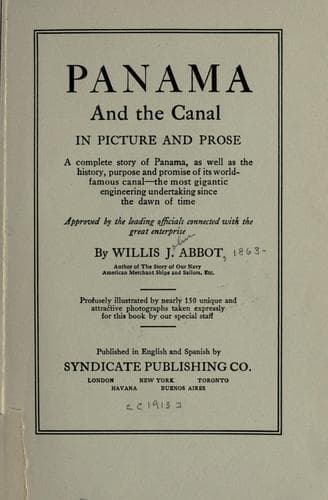
Panama and the Canal in Picture and ProseAbbot, Willis J. (Willis John)
History
Panama and the Canal in Picture and Prose
Abbot, Willis J. (Willis John)
Panama Canal (Panama) -- History
“The malaria sick rate for 1906, if continued to 1911, would give, on
the basis of the number of employees in 1911, about 40,000 cases of
malaria sick in the hospitals for the year, or a loss in labor of about
200,000 days of work. The total number of employees sick in hospitals
with malaria in 1911 was 8946--or a loss of 44,730 days of work. A gain
of about 155,000 days was, therefore, made. Placing the loss to the
Government for each day’s labor, plus treatment, at the rather low
figure of $3 per man, the gain in this one item of saving more than
offset the cost of sanitation proper. These figures do not include
malarial cases treated in the dispensaries and in homes. Among this
class of patients the gain has undoubtedly been proportionate to the
gain in hospital cases, and in addition it must not be forgotten that
malaria is a disease that undermines a man’s health insidiously and
lowers his working efficiency to an extent not approached by any disease
with the possible exception of hook-worm. The less malaria the fewer
inefficient workers in an organization”.
[Illustration: IN PICTURESQUE TABOGA]
Of course the screening system was vital to any successful effort to
control and check the transmission of fever germs by insects. But the
early struggles of Col. Gorgas to get enough wire netting to properly
protect the labor quarters were pathetic. “Why doesn’t he screen in the
whole Isthmus and let it go at that”? inquired one Congressman who
thought it was all intended to put a few more frills on houses for
already highly paid workers. The screening has indeed cost a pretty
penny for only the best copper wire will stand the test of the climate.
At first there was reluctance on the part of disbursing officers to meet
the heavy requirements of Col. Gorgas. But the yellow-fever epidemic of
1905 stopped all that. Thereafter the screening was regarded as much of
an integral part of a house as its shingling.
The efforts that were put forth to make the Canal Zone a liveable spot
have not been relaxed in keeping it so. A glance at the report of the
Chief Sanitary Officer for any year shows something of his continued
activity. You find records of houses fumigated for beriberi, diphtheria,
malaria, leprosy, and a dozen other evils. The number of rats killed is
gravely enumerated--during the year 1911 for example there were nearly
13,000. It may be noted in passing that the rats distribute fleas and
fleas carry the germs of the bubonic plague, hence the slaughter.
Incidentally guests of the native hotels in Panama City say that the
destruction was far from complete.
[Illustration: IN THE GROUNDS OF ANCON HOSPITAL]
Public-domain text, read in full here on John Shaqi.
Reviews
Reviews
No reviews yet
Be the first to share your thoughts on this work.
Elsewhere in the archive
Join the Discussion
Join the discussion
Sign in to leave a comment or review.
Sign InorCreate an account