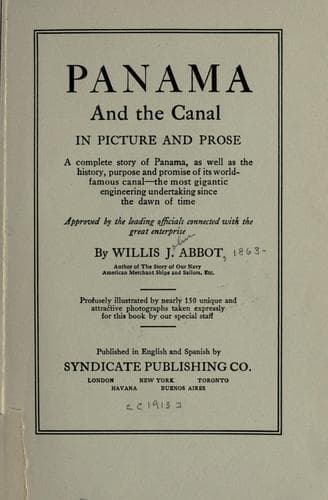
Panama and the Canal in Picture and ProseAbbot, Willis J. (Willis John)
History
Panama and the Canal in Picture and Prose
Abbot, Willis J. (Willis John)
Panama Canal (Panama) -- History
The soil of the Republic differs widely in its varying sections, from
the rich vegetable loam of the lowlands along the Atlantic Coast, the
outcome of years of falling leaves and twigs from the trees to the swamp
below, to the high dry lands of the savannas and the hillsides of the
Chiriqui province. All are undeniably fertile, that is demonstrated by
the rapid and rank growth of the jungle. But opinions differ as to the
extent to which they are available for useful agriculture. Some hold
that the jungle soil is so rich that the plants run to wood and leaves
to the exclusion of fruits. Others declare that on the hillsides the
heavy rains of the rainy seasons wash away the surface soil leaving only
the harsh and arid substratum. This theory seems to be overthrown by the
fact that it is rare to see a hillside in all Panama not covered with
dense vegetation. A fact that is well worth bearing in mind is that
there has never been a systematic and scientific effort to utilize any
part of the soil of Panama for productive purposes that has not been a
success. The United Fruit Company in its plantations about Bocas del
Toro has developed a fruitful province and created a prosperous town. In
the province of Cocle a German company has set out about 75,000 cacao
trees, 50,000 coffee bushes and 25,000 rubber trees, all of which have
made good progress.
[Illustration: THE HOTEL AT DAVID]
The obstacles in the path of the fuller development of the national
resources of Panama have sprung wholly from the nature of its
population. The Indian is, of course, not primarily an agriculturist,
not a developer of the possibilities of the land he inhabits. The
Spanish infusion brought to the native population no qualities of
energy, of well-directed effort, of the laborious determination to build
up a new and thriving commonwealth. Spanish ideals run directly counter
to those involved in empire building. Such energy, such determination as
built up our great northwest and is building in British Columbia the
greatest agricultural empire in the world, despite seven months annually
of drifting snow and frozen ground, would make of the Panama savannas
and valleys the garden spot of the world. That will never be
accomplished by the present agrarian population, but it is incredible
that with population absorbing and overrunning the available
agricultural lands of other zones, the tropics should long be left
dormant in control of a lethargic and indolent people.
[Illustration: VIEW OF BOCAS DEL TORO]
[Illustration: _Photo by Critchlow_
VISTA ON THE RIO GRANDE]
Benjamin Kidd, in his stimulative book, “Social Evolution”, says on this
subject:
Public-domain text, read in full here on John Shaqi.
Reviews
Reviews
No reviews yet
Be the first to share your thoughts on this work.
Elsewhere in the archive
Join the Discussion
Join the discussion
Sign in to leave a comment or review.
Sign InorCreate an account