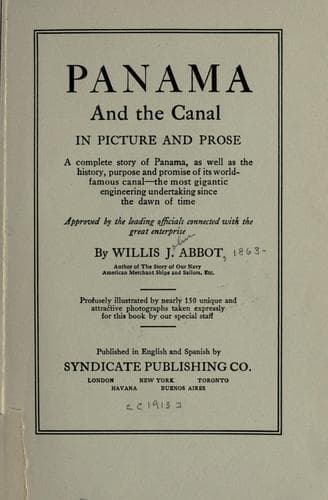
Panama and the Canal in Picture and ProseAbbot, Willis J. (Willis John)
History
Panama and the Canal in Picture and Prose
Abbot, Willis J. (Willis John)
Panama Canal (Panama) -- History
Once a week Miguel’s father went down to market at Matachin, and
sometimes the boy went along. The long, narrow cayuca was loaded with
oranges, bananas and yams, all covered with big banana leaves, and with
Miguel in the bow and his father in the stern the voyage commenced.
Going down stream was easy enough, and the canoists plied their paddles
idly, trusting chiefly to the current to carry them along. But coming
back would be the real work, then they would have to bend to their poles
and push savagely to force the boat along. At places they would have to
get overboard and fairly carry the boat through the swift, shallow
rapids. But Miguel welcomed the work for it showed him the wonders of
Matachin, where great iron machines rushed along like horses, drawing
long trains of cars; where more people worked with shovels tending queer
machines than there were in ten towns like Cruces; where folk gave pesos
for bananas and gave cloth, powder and shot, things to eat in cans, and
rum in big bottles for the pesos again. It was an exciting place this
Matachin and made Miguel understand what the gringoes meant when they
talked about New York, Chicago and other cities like it.
[Illustration: BANANA MARKET AT MATACHIN]
When he grew older Miguel worked awhile for the men who were digging
away all this dirt, and earned enough to buy himself a machete and a gun
and a few ornaments for a girl named Maria who lived in another hut near
the river. But what was the use of working in that mad way--picking up
your shovel when a whistle blew and toiling away until it blew again,
with a boss always scolding at you and ready with a kick if you tried to
take a little siesta. The pesos once a week were good, that was true. If
you worked long enough you might get enough to buy one of those boxes
that made music, but _quien sabe?_ It might get broken anyway, and the
iguanas in the jungle, the fish in the river and the yams and bananas in
the clearing needed no silver to come to his table. Besides he was
preparing to become a man of family. Maria was quite willing, and so one
day they strolled off together hand in hand to a clearing Miguel had
made with his machete on the river bank. With that same useful tool he
cut some wooden posts, set them erect in the ground and covered them
with a heavy thatch of palmetto leaves impervious to sun or rain. The
sides of the shelter were left open during the first months of wedded
life. Later perhaps, when they had time they would go to Cruces at the
period of the priest’s regular visit and get regularly married. When the
rainy season came on and walls were as necessary as a roof against the
driving rain, they would build a little better. When that time came he
would set ten stout uprights of bamboo in the ground in the shape of an
oblong, and across the tops would fasten six cross pieces of girders
with withes of vine well soaked to make them pliable. This would make
the frame of the first floor of his house.
Public-domain text, read in full here on John Shaqi.
Reviews
Reviews
No reviews yet
Be the first to share your thoughts on this work.
Elsewhere in the archive
Join the Discussion
Join the discussion
Sign in to leave a comment or review.
Sign InorCreate an account