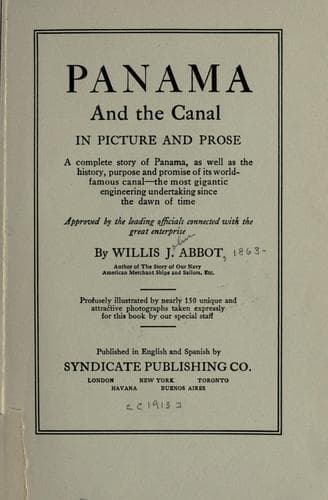
Panama and the Canal in Picture and ProseAbbot, Willis J. (Willis John)
History
Panama and the Canal in Picture and Prose
Abbot, Willis J. (Willis John)
Panama Canal (Panama) -- History
While native architecture is not stately it is artistic in that it
harmonizes with its natural surroundings and is eminently adapted to the
needs of the people who inhabit the huts.]
It is beyond doubt to the ease with which life can be sustained, and the
torpidity of the native imagination which depicts no joys to spur one on
to effort that the unwillingness of the native to do systematic work is
due. And from this difficulty in getting labor follows the fact that
not one quarter of the natural resources of Panama are developed.
Whether the labor problem will be solved by the distribution throughout
the republic of the Caribbean blacks who have worked so well on the Zone
is yet to be seen. It may be possible that because of this the fertile
lands of Panama, or the savannas so admirably fitted for grazing, can
only be utilized by great corporations who will do things on so great a
scale as to justify the importation of labor. Today the man who should
take up a large tract of land in the Chiriqui country with a view to
tilling it would be risking disaster because of the uncertainty of the
labor supply.
[Illustration: CONSTRUCTION OF ROOF OF A NATIVE HOUSE
The photograph is taken looking directly upward from the ground floor]
Another obstacle in the way of foreign settlement of Panama has been the
uncertainty of land titles. Early surveyors seem to have been in the
habit of noting as the identification marks of their lines such volatile
objects as a blackbird in a tree, or such perishable ones as an ant hill
or a decaying stump. Facilities for recording titles also have been ill
arranged. One of the first tasks of the new Republic was to take up this
matter and it has been reduced to fairly systematic form. The Republic
is offering for sale great quantities of public lands long held as
commons by various municipalities. Much of this land lies along the line
of the railroad from Panama to David, and is of varying grades suitable
for grazing, forestry or agriculture. A fixed price of 50 cents per
hectare is charged, a hectare being practically 2¹⁄₂ acres. The
government has gone quite efficiently into the task of disposing of
these lands, and pamphlets explanatory of methods of securing titles,
terms, etc., can be obtained by addressing the Administrator-General at
Panama. The Pan-American Union, of Washington, D. C., has issued a
pamphlet giving a summary in English of the Panamanian law bearing upon
the subject.
[Illustration: A NATIVE LIVING ROOM AND STAIRWAY
By pulling up the bamboo ladder, or turning it, communication with the
upper floor is closed]
Public-domain text, read in full here on John Shaqi.
Reviews
Reviews
No reviews yet
Be the first to share your thoughts on this work.
Elsewhere in the archive
Join the Discussion
Join the discussion
Sign in to leave a comment or review.
Sign InorCreate an account