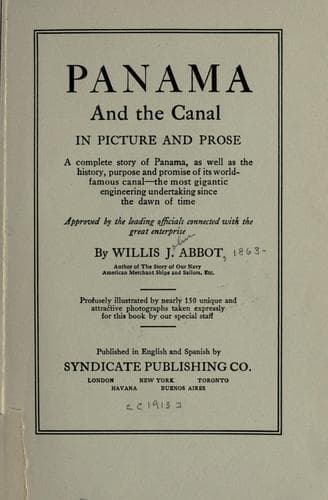
Panama and the Canal in Picture and ProseAbbot, Willis J. (Willis John)
History
Panama and the Canal in Picture and Prose
Abbot, Willis J. (Willis John)
Panama Canal (Panama) -- History
With the lack of labor, and the uncertainty of land titles, the final
impediment to the general development of the interior of Panama is to be
found in the lack of roads. It is not that the roads are bad--that is
the case in many of our own commonwealths. But in a great part of Panama
there are literally no roads at all. Trails, choked by the jungle and so
washed by the rains that they are merely lanes floored with boulders,
are the rule. The heavy ox-cart is the only vehicle that will stand the
going, and our light American farm wagons would be speedily racked to
pieces. In the Canal Zone the Commission has built some of the best
roads in the world, utilizing the labor of employees convicted of minor
offenses. Stimulated by this example the Panama government has built one
excellent road from the chief city across the savannas to Old Panama and
thence onward into the interior. It is hoped that the spectacle of the
admirable roads in the Zone will encourage the authorities of the
Republic to go into road building on a large scale in their own country.
In no other way can its possibilities be realized. At present the rivers
afford the surest highways and land abutting them brings higher prices.
[Illustration: RUBBER PLANTATION NEAR COCLE
The planter’s original hut in the foreground. The board cabin with
corrugated iron roof shows prosperity]
David, the largest interior town of Panama, is the central point of the
cattle industry. All around it are woods, or jungles, plentifully
interspersed with broad prairies, or llanos, covered with grass, and on
which no trees grow save here and there a wild fig or a ceibo. Cattle
graze on the llanos, sleek reddish beasts with spreading horns like our
Texas cattle. There are no huge herds as on our western ranges. Droves
of from ten to twenty are about the average among the small owners who
rely on the public range for subsistence. The grass is not sufficiently
nutritious to bring the cattle up to market form, so the small owners
sell to the owners of big ranches who maintain potreros, or fattening
ground sown with better grasses. A range fed steer will fetch $15 to
$18, and after six or eight months on the potrero it will bring $30 to
$35 from the cattle shipper at David. Since the cost of feeding a beeve
for that period is only about one dollar, and as the demand is fairly
steady the profit of the ranchman is a good one. But like all other
industries in Panama, this one is pursued in only a retail way. The
market is great enough to enrich ranchmen who would go into the business
on a large scale, but for some reason none do.
[Illustration: BOLIVAR PARK AT BOCAS DEL TORO]
Public-domain text, read in full here on John Shaqi.
Reviews
Reviews
No reviews yet
Be the first to share your thoughts on this work.
Elsewhere in the archive
Join the Discussion
Join the discussion
Sign in to leave a comment or review.
Sign InorCreate an account