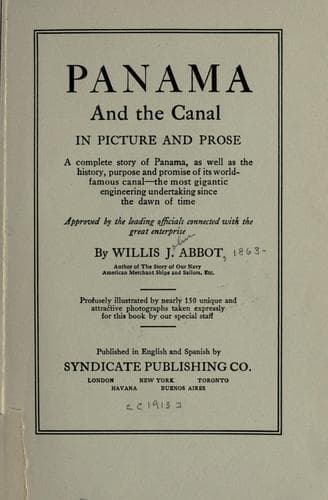
Panama and the Canal in Picture and ProseAbbot, Willis J. (Willis John)
History
Panama and the Canal in Picture and Prose
Abbot, Willis J. (Willis John)
Panama Canal (Panama) -- History
The fruits of Panama are the orange, which grows wild and for the proper
cultivation of which no effort has been made, which is equally the case
with the lemon and the lime; the banana, which plays so large a part in
the economic development of the country that I shall treat of it at
length later; the pineapple, cultivated in a haphazard way, still
attains so high an order of excellence that Taboga pines are the
standard for lusciousness; the mango, which grows in clusters so dense
that the very trees bend under their weight, but for which as yet little
market has been found, as they require an acquired taste; the mamei,
hard to ship and difficult to eat because of its construction but withal
a toothsome fruit; the paypaya, a melon not unlike our cantaloupe which
has the eccentricity of growing on trees; the sapodillo, a fruit of
excellent flavor tasting not unlike a ripe persimmon, but containing no
pit. With cultivation all of these fruits could be grown in great
quantities in all parts of the Republic, but to give them any economic
importance some special arrangement for their regular and speedy
marketing would have to be made, as with the banana, most of them being
by nature extremely perishable.
Northern companies are finding some profit in exploiting such natural
resources of Panama as are available in their wild state. Of these the
most promising is rubber, the tree being found in practically every part
of the country. One concern, the Boston-Panama Company, has an estate
approximating 400 square miles on which are about 100,000 wild rubber
trees, and which is being further developed by the planting of bananas,
pineapples, cocoanuts and other tropical fruits.
[Illustration: WAITING FOR THE BOAT]
Coffee, sugar and cacao are raised on the Isthmus, but of the two former
not enough to supply the local demand. The development of the cacao
industry to large proportions seems probable, as several foreign
corporations are experimenting on a considerable scale. Cocoanuts are
easily grown along both coasts of the Isthmus. A new grove takes about
five years to come into bearing, costing an average of about three
dollars a tree. Once established the trees bring in a revenue of about
one dollar each at present prices and, as the demand for Panama
cocoanuts is steady, the industry seems to offer attractive
possibilities. The groves must be near the coast, as the cocoanut tree
needs salt air to reach its best estate. Given the right atmospheric
conditions they will thrive where no other plant will take root. Growing
at the edge of the sea, water transportation is easy.
[Illustration: COUNTRY HOUSE OF A CACAO PLANTER AT CHORIA
This industry is in its infancy in Panama, but promises to be a
considerable resource]
[Illustration: STARTED FOR MARKET]
Public-domain text, read in full here on John Shaqi.
Reviews
Reviews
No reviews yet
Be the first to share your thoughts on this work.
Elsewhere in the archive
Join the Discussion
Join the discussion
Sign in to leave a comment or review.
Sign InorCreate an account