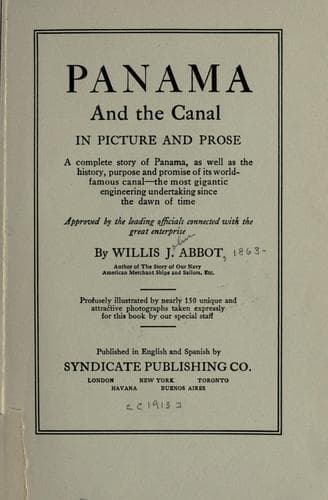
Panama and the Canal in Picture and ProseAbbot, Willis J. (Willis John)
History
Panama and the Canal in Picture and Prose
Abbot, Willis J. (Willis John)
Panama Canal (Panama) -- History
Passing from llano to llano the road cuts through the forest which
towers dense and impenetrable on either side, broken only here and
there by small clearings made by some native with the indispensable
machete. These in the main are less than four acres. The average
Panamanian farmer will never incur the scriptural curse laid upon them
that lay field unto field. He farms just enough for his daily needs, no
more. The ambition that leads our northern farmer to always covet the
lands on the other side of his boundary fence does not operate in
Panama. One reason is, of course, the aggressiveness of the jungle.
Stubborn to clear away, it is determined in its efforts to regain the
land from which it has been ousted. Such a thing as allowing a field to
lie fallow for two or three years is unknown in Panama. There would be
no field visible for the new jungle growth.
[Illustration: A FORD NEAR ANCON]
Agriculture therefore is conducted in a small way only, except for the
great corporations that have just begun the exploitation of Panama.
Whether the country affords a hopeful field for the individual settler
is at least doubtful. Its climate is excellent. The days are warm but
never scorchingly hot as are customary in Washington and frequent in New
York. The nights are cool. From December to May a steady trade wind
blows over the Isthmus from north to south, carrying away the clouds so
that there is no rain. In this dry season the fruits mature, so that it
corresponds to the northern summer; on the other hand such vegetation as
sheds its leaves, or dies down annually, does so at this season, giving
it a seeming correspondence to the northern winter. In a temperature
sense there is neither summer nor winter, and the variation of the
thermometer is within narrow limits. The highest temperature in years at
Culebra, a typical inland point, was 96 degrees; the lowest 61.
The list of natural products of the Isthmus is impressive in its length
and variety, but for most of them even the home demand is not met or
supplied by the production. Only where some stimulating force from the
outside has intervened, like the United Fruit Company with the banana,
has production been brought up to anything like its possibility. In the
Chiriqui country you can see sugar cane fields that have gone on
producing practically without attention for fifteen seasons. Cornfields
have been worked for half a century without fertilizing or rotation of
crops. The soil there is volcanic detritus washed down during past ages
from the mountainsides, and lies from six to twenty feet thick. It will
grow anything that needs no frost, but the province supports less than
four people to the square mile, nine-tenths of the land is unbroken and
Panama imports fruit from Jamaica, sugar from Cuba and tobacco and food
stuffs from the United States.
[Illustration: OLD BANANA TREES]
[Illustration: PINEAPPLES IN THE FIELD]
Public-domain text, read in full here on John Shaqi.
Reviews
Reviews
No reviews yet
Be the first to share your thoughts on this work.
Elsewhere in the archive
Join the Discussion
Join the discussion
Sign in to leave a comment or review.
Sign InorCreate an account