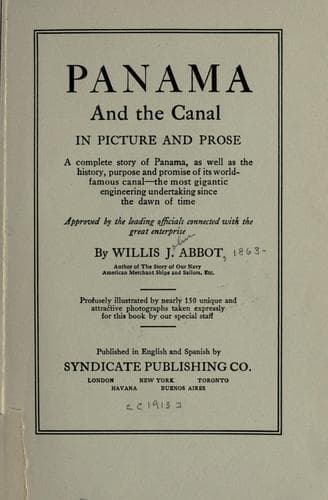
Panama and the Canal in Picture and ProseAbbot, Willis J. (Willis John)
History
Panama and the Canal in Picture and Prose
Abbot, Willis J. (Willis John)
Panama Canal (Panama) -- History
The banana business is the great trade of the tropics, and one that
cannot be reduced in volume by new competition, as cane sugar was
checked by beet sugar. But it is a business which requires special
machinery of distribution for its success. From the day the banana is
picked until it is in the stomach of the ultimate consumer the time
should not exceed three weeks. The fruit must be picked green, as, if
allowed to ripen on the trees, it splits open and the tropical insects
infect it. This same condition, by the way, affects all tropical fruits.
All must be gathered while still unripe. The nearest wholesale market
for bananas is New Orleans, five days’ steaming. New York is seven days
away. That means that once landed the fruit must be distributed to
commission houses and agents all over the United States with the utmost
expedition lest it spoil in transit. There can be no holding it in
storage, cold or otherwise, for a stronger demand or a higher market.
This means that the corporation must deal with agents who can be relied
upon to absorb the cargoes of the ships as regularly as they arrive.
From its budding near the Panama Canal to its finish in the alimentary
canal of its final purchaser the banana has to be handled systematically
and swiftly.
[Illustration: BRINGING HOME THE CROCODILE]
[Illustration: A MORNING’S SHOOTING]
To establish this machinery the United Fruit Company has invested more
than $190,000,000 in the tropics--doubtless the greatest investment next
to the Panama Canal made in that Zone. How much of this is properly a
Panama investment can hardly be told, since for example the Fruit
Company’s ships which ply to Colon and Bocas del Toro call at other
banana ports as well. These ships are peculiarly attractive in design
and in their clothing of snowy white, and I do not think there is any
American who, seeing them in Caribbean ports, does not wonder at the
sight of the British flag flying at the stern. His astonishment is not
allayed when he learns that the company has in all more than 100 ships
of various sizes, and nearly all of British registry. The transfer of
that fleet alone to American registry would be a notable and most
desirable step.
[Illustration: ON CROCODILE CREEK
Each spot looking like a leaf on the water is the nose of a submerged
saurian]
Public-domain text, read in full here on John Shaqi.
Reviews
Reviews
No reviews yet
Be the first to share your thoughts on this work.
Elsewhere in the archive
Join the Discussion
Join the discussion
Sign in to leave a comment or review.
Sign InorCreate an account