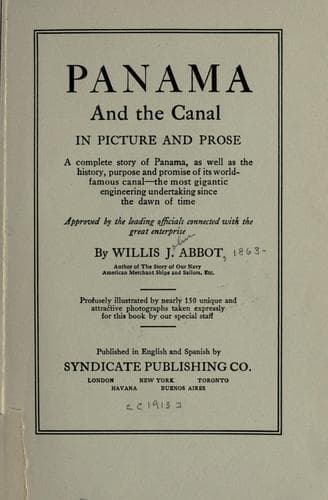
Panama and the Canal in Picture and ProseAbbot, Willis J. (Willis John)
History
Panama and the Canal in Picture and Prose
Abbot, Willis J. (Willis John)
Panama Canal (Panama) -- History
From officials of the company I learned that they would welcome the
opportunity to transfer their ships to American registry, except for
certain requirements of the navigation laws which make such a change
hazardous. Practically all the ownership of the ships is vested in
Americans, but to fly the British flag is for them a business necessity.
Chief among the objections is the clause which would give the United
States authority to seize the vessels in time of war. It is quite
evident that this power might be employed to the complete destruction of
the Fruit Company’s trade; in fact to its practical extinction as a
business concern. A like power existing in England or Germany would not
be of equal menace to any single company flying the flag of that nation,
for there the government’s needs could be fully supplied by a proper
apportionment of requisitions for ships among the many companies. But
with the exceedingly restricted merchant marine of the United States the
danger of the enforcement of this right would be an ever-present menace.
It is for this reason that the Fruit Company steamers fly the British
flag, and the American in Colon may see, as I did one day, nine great
ocean ships in the port with only one flying the stars and stripes. The
opening of the canal will not wholly remedy this.
[Illustration: _Photo by Carl Hayden_
THE END OF THE CROCODILE]
In all respects save the registry of its ships, however, the Fruit
Company is a thoroughly American concern and to its operations in the
Caribbean is due much of the good feeling toward the United States which
is observable there. In 1912 it carried 1,113,741 tons of freight, of
which 359,686 was general freight, carried for the public in addition
to company freight. This is a notable public service, profitable no
doubt but vital to the interests of the American tropics. It owns or
holds under leases 852,650 acres, and in 1912 carried to the United
States about 25,000,000 bunches of bananas, and 16,000,000 bunches to
Great Britain and the Continent. Viewed from the standpoint of the
consumer its work certainly has operated to cheapen bananas and to place
them on sale at points where they were never before seen. The banana has
not participated in the high cost of living nor has one company
monopolized the market, for the trade statistics show 17,000,000 bunches
of bananas imported by rival companies in 1912. As for its stimulation
of the business of the ports of New Orleans, Galveston and Mobile, and
its revivifying of trade along the Caribbean, both are matters of common
knowledge.
[Illustration: ABOVE THE CLOUDS, CHIRIQUI VOLCANO]
Public-domain text, read in full here on John Shaqi.
Reviews
Reviews
No reviews yet
Be the first to share your thoughts on this work.
Elsewhere in the archive
Join the Discussion
Join the discussion
Sign in to leave a comment or review.
Sign InorCreate an account