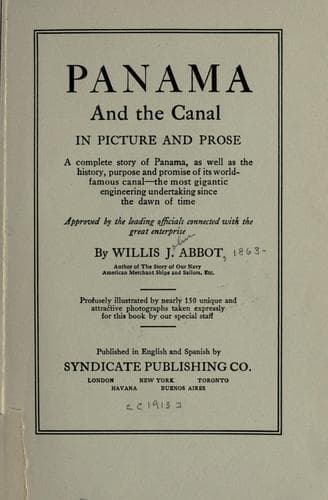
Panama and the Canal in Picture and ProseAbbot, Willis J. (Willis John)
History
Panama and the Canal in Picture and Prose
Abbot, Willis J. (Willis John)
Panama Canal (Panama) -- History
The banana thrives best in rich soil covered with alluvial deposits and
in a climate of great humidity where the temperature never falls below
75 degrees Fahrenheit. Once established the plantation needs little
attention, the plant being self-propagating from suckers which shoot off
from the “mat,” the tangled roots of the mother plant. It begins to bear
fruit at the age of ten or eleven months, and with the maturing of one
bunch of fruit the parent plant is at once cut down so that the strength
of the soil may go into the suckers that succeed it. Perhaps the most
technical work of the cultivator is to select the suckers so that the
plantation will not bring all its fruit to maturity in one season, but
rather yield a regular succession of crops, month after month. It was
interesting to learn from a representative of the United Fruit Company
at Bocas del Toro, that the banana has its dull season--not in
production but in the demand for it which falls off heavily in winter,
though one would suppose that summer, when our own fruits are in the
market, would be the period of its eclipse.
[Illustration: THE CHIRIQUI VOLCANO]
[Illustration: NATIVE MARKET BOAT AT CHORRERA]
While most of the fruit gathered in the neighborhood of Bocas del Toro
is grown on land owned and tilled by the Company, there are hundreds of
small individual growers with plantations of from half an acre to fifty
acres or even more. All fruit is delivered along the railway lines, and
the larger growers have tramways, the cars drawn by oxen or mules, to
carry their fruit to the stipulated point. Notice is given the growers
of the date on which the fruit will be called for, and within twelve to
eighteen hours after it has been cut it is in the hold of the vessel. It
is subjected to a rigid inspection at the docks, and the flaws for which
whole bunches are rejected would often be quite undiscernible to the
ordinary observer.
[Illustration: IN BOUQUETTE VALLEY, THE MOST FERTILE PART OF CHIRIQUI]
The banana is one of the few fruits which are free from insect pests,
being protected by its thick, bitter skin. If allowed to ripen in the
open, however, it speedily falls a prey to a multitude of egg-laying
insects. The tree itself is not so immune. Lately a small rodent,
something like the gopher of our American states, has discovered that
banana roots are good to eat. From time immemorial he lived in the
jungle, burrowing and nibbling the roots of the plants there, but in an
unlucky moment for the fruit companies he discovered that tunneling in
soil that had been worked was easier and the roots of the cultivated
banana more succulent than his normal diet. Therefore a large
importation of scientists from Europe and the United States to find some
way of eradicating the industrious pest that has attacked the chief
industry of the tropics at the root, so to speak.
[Illustration: COFFEE PLANT AT BOUQUETTE]
Public-domain text, read in full here on John Shaqi.
Reviews
Reviews
No reviews yet
Be the first to share your thoughts on this work.
Elsewhere in the archive
Join the Discussion
Join the discussion
Sign in to leave a comment or review.
Sign InorCreate an account