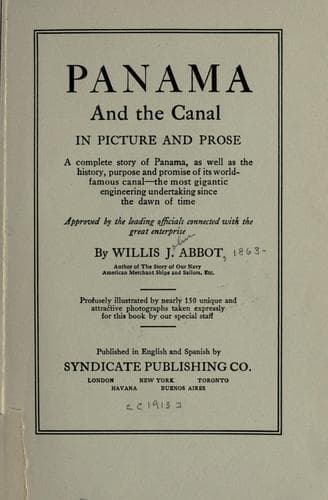
Panama and the Canal in Picture and ProseAbbot, Willis J. (Willis John)
History
Panama and the Canal in Picture and Prose
Abbot, Willis J. (Willis John)
Panama Canal (Panama) -- History
Early on the second day out from Cuba a heavy gray mass showed clear on
the horizon to the southwest. It is reported by the historians that when
Queen Isabella once asked Columbus what Jamaica looked like he crumpled
up a sheet of stiff paper in his palm, then partly smoothing it
displayed it to the Queen. The illustration was apt. Nowhere does a more
crinkly island rise from the sea. Up to a height of 7000 feet and more
the mountains rise sheer from the sea with only here and there the
narrowest strip of white beach at the base. For the most part the
tropical foliage comes unthinned down to the water. In early morn the
crests of the hills are draped with clouds, and from the valleys betwixt
them masses of white mist come rolling out as the rays of the sun heat
the atmosphere. For forty miles or so you steam along this coast with
scarce an acre of level land between the mountains and the deep until in
the distance you descry the hollow in which Kingston lies embedded. A
low lying sand bar runs parallel to the shore and perhaps a mile out,
forming the barrier for the harbor which is indeed a noble bay well fit
to shelter navies. But the barrier, though but a few feet above high
water now, is sinking gradually, and the future of Kingston’s harbor is
somewhat distressing. Once this low sandbar bore the most riotous and
wicked town of history, for here stood Port Royal to which flocked the
pirates and buccaneers of the Spanish Main, with their booty--doubloons,
pieces of eight, beauteous Spanish señoritas and all the other
attractive plunder with which the dime novels of our youth made us
familiar. A right merry spot was Port Royal in those days and a pistol
bullet or a swift stab in the back, though common enough, only halted
the merriment for one man at a time. But fire purged Port Royal, and the
pleasant pursuit of piracy began to fall into disrepute. Instead of
treating the gallants who sailed under the Jolly Roger as gentlemen
adventurers, civilized governments began to hang them--England being the
last to countenance them in making Henry Morgan, wildest of the reckless
lot, a baronet, and appointed him governor of Jamaica. Now Port Royal
has shrunken to a fishing village, bordering upon the abandoned British
naval station at the very harbor’s mouth.
[Illustration: GOVERNMENT BUILDINGS, KINGSTON
The special type of reënforced concrete buildings with broad arcades is
well adapted to the tropics]
One sees there the emplacements for guns, but no guns; the barracks for
marines, but no men. Even the flagstaff rises dismally destitute of
bunting. No sign of military or naval life appears about the harbor. The
first time I visited it a small British gunboat about the size of our
“Dolphin” dropped anchor and sent four boatloads of jackies ashore for a
frolic, but on my second visit the new Governor of the colony arrived on
a Royal Mail ship, unescorted by any armed vessel, and was received
without military pomp or the thunder of cannon.
Public-domain text, read in full here on John Shaqi.
Reviews
Reviews
No reviews yet
Be the first to share your thoughts on this work.
Join the Discussion
Join the discussion
Sign in to leave a comment or review.
Sign InorCreate an account