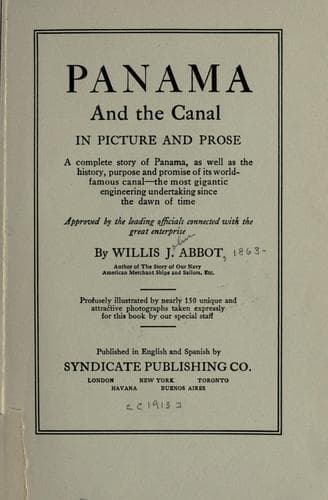
Panama and the Canal in Picture and ProseAbbot, Willis J. (Willis John)
History
Panama and the Canal in Picture and Prose
Abbot, Willis J. (Willis John)
Panama Canal (Panama) -- History
Death came fast to those in the jungle. The agonies they suffered from
starvation, exposure and insect pests baffle description. “Truxton in
casting his eyes on the ground saw a toad”, wrote the historian.
“Instantly snatching it up, he bit off the head and, spitting it away,
devoured the body. Maury looked at him a moment, and then picked up the
rejected head, saying, ‘Well, Truxton, you are getting quite particular.
Something of an epicure, eh’? With these words he quietly devoured the
head himself.”
Nine of the twenty-seven men who entered the Darien with Strain died.
When the leader returned with the relief party they were found, like
Greely at Camp Starvation, unable to move and slowly dying. Those who
retained life never fully regained strength. Every condition which
brought such frightful disaster upon the Strain party exists in the
Darien today. The Indians are as hostile, the trails as faintly
outlined, the jungle as dense, the insects as savage. Only along the
banks of the rivers has civilization made some little headway, but the
richest gold field twenty miles back in the interior is as safe from
civilized workings as though it were walled in with steel and guarded by
dragons. Every speculative man you meet in Panama will assure you that
the gold is there but all agree that conditions must be radically
changed before it can be gotten out unless a regiment and a subsistence
train shall follow the miners.
[Illustration: A RIVER LANDING PLACE]
The authorities of Panama estimate that there are about 36,000 tribal
Indians, that is to say aborigines, still holding their tribal
organizations and acknowledging fealty to no other government now in the
Isthmus. The estimate is of course largely guesswork, for few of the
wild Indians leave the jungle and fewer still of the census enumerators
enter it. Most of these Indians live in the mountains of the provinces
of Bocas del Toro, Chiriqui and Veragua, or in the Darien. Their tribes
are many and the sources of information concerning them but few. The
most accessible and complete record of the various tribes is in a
pamphlet issued by the Smithsonian Institution, and now obtainable only
through public libraries, as the edition for distribution has been
exhausted. The author, Miss Eleanor Yorke Bell, beside studies made at
first hand has diligently examined the authorities on the subject and
has presented the only considerable treatise on the subject of which I
have knowledge.
[Illustration: THE FALLS AT CHORRERA]
[Illustration: _Photo by Underwood, & Underwood_
ON THE RIO GRANDE]
Of life among the more civilized natives she says:
Public-domain text, read in full here on John Shaqi.
Reviews
Reviews
No reviews yet
Be the first to share your thoughts on this work.
Elsewhere in the archive
Join the Discussion
Join the discussion
Sign in to leave a comment or review.
Sign InorCreate an account