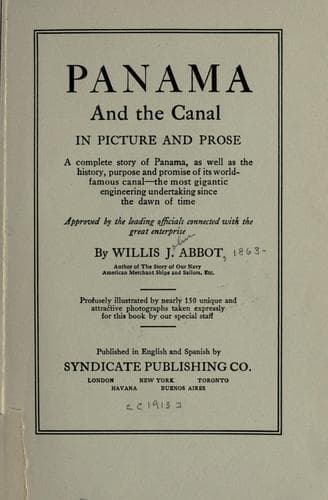
Panama and the Canal in Picture and ProseAbbot, Willis J. (Willis John)
History
Panama and the Canal in Picture and Prose
Abbot, Willis J. (Willis John)
Panama Canal (Panama) -- History
“The natives of the Isthmus in general, even in the larger towns, live
together without any marriage ceremony, separating at will and dividing
the children. As there is little or no personal property, this is
accomplished amicably as a rule, though should disputes arise the
alcalde of the district is appealed to, who settles the matter. This
informal system is always stoutly defended by the women, even more than
by the men, for, as among all people low in the scale of civilization,
it is generally held that the women receive better treatment when not
bound and therefore free to depart at any time. Recently an effort has
been made to bring more of the inhabitants under the marriage laws, with
rather amusing results in many instances. The majority of the population
is nominally Catholic, but the teachings of the church are only vaguely
understood, and its practices consist in the adoration of a few battered
images of saints whose particular degree of sanctity is not even guessed
at and who, when their owners are displeased with them, receive rather
harsh treatment, as these people have usually no real idea of
Christianity beyond a few distorted and superstitious beliefs. After the
widespread surveys of the French engineers, a sincere effort was made to
re-Christianize the inhabitants of the towns in Darien as well as
elsewhere, for, until this time, nothing had been done toward their
spiritual welfare since the days of the early Jesuits. In the last
thirty years spasmodic efforts have been made to reach the people with
little result, and, excepting at Penonome, David, and Santiago, there
are few churches where services are held outside of Panama and the towns
along the railroad.
[Illustration: OLD SPANISH CHURCH, CHORRERA]
“The chief amusements of the Isthmian are gambling, cock-fighting, and
dancing, the latter assisted by the music of the tom-tom and by dried
beans rattled in a calabash. After feasts or burials, when much bad rum
and whisky is consumed, the hilarity keeps up all night and can be heard
for miles, increased by the incessant howls of the cur dogs lying under
every shack. Seldom does an opportunity come to the stranger to witness
the really characteristic dances, as the natives do not care to perform
before them, though a little money will sometimes work wonders.
Occasionally, their dancing is really remarkably interesting, when a
large amount of pantomime enters into it and they develop the story of
some primitive action, as, for instance, the drawing of the water,
cutting the wood, making the fire, cooking the food, etc., ending in a
burst of song symbolizing the joys of the new prepared feast. In an
extremely crude form it reminds one of the old opera ballets and seems
to be a composite of the original African and the ancient Spanish, which
is very probably the case.
[Illustration: THE CHURCH AT ANCON]
Public-domain text, read in full here on John Shaqi.
Reviews
Reviews
No reviews yet
Be the first to share your thoughts on this work.
Elsewhere in the archive
Join the Discussion
Join the discussion
Sign in to leave a comment or review.
Sign InorCreate an account