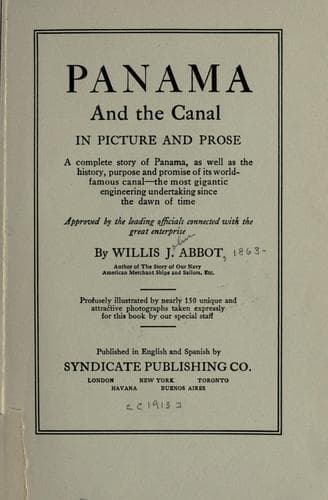
Panama and the Canal in Picture and ProseAbbot, Willis J. (Willis John)
History
Panama and the Canal in Picture and Prose
Abbot, Willis J. (Willis John)
Panama Canal (Panama) -- History
“The Orientals of the Isthmus deserve a word in passing. They are
chiefly Chinese coolies and form a large part of the small merchant
class. Others, in the hill districts, cultivate large truck gardens,
bringing their produce swinging over the shoulders on poles to the city
markets. Their houses and grounds are very attractive, built of reed or
bamboo in the eastern fashion and marked everywhere by extreme neatness,
contrasting so strikingly with the homes and surroundings of their negro
neighbors. Many cultivate fields of cane or rice as well, and amidst the
silvery greens, stretching for some distance, the quaint blue figures of
the workmen in their huge hats make a charming picture. Through the
rubber sections Chinese ‘middlemen’ are of late frequently found buying
that valuable commodity for their fellow countrymen in Panama City, who
are now doing quite a large business in rubber. These people live much
as in their native land, seldom learning more than a few words of
Spanish (except those living in the towns), and they form a very
substantial and good element of the population”.
[Illustration: THE PEARL ISLAND VILLAGE OF SABOGA]
To enumerate even by names the aboriginal tribes would be tedious and
unavailing. Among the more notable are the Doracho-Changuina, of
Chiriqui, light of color, believing that the Great Spirit lived in the
volcano of Chiriqui, and occasionally showing their displeasure with him
by shooting arrows at the mountain. The Guaymies, of whom perhaps 6000
are left, are the tribe that buried with their dead the curious golden
images that were once plentiful in the bazaars of Panama, but are now
hard to find. They have a pleasant practice of putting a calabash of
water and some plantains by a man they think dying and leaving him to
his fate, usually in some lonesome part of the jungle. The Cunas or
Caribs are the tribes inhabiting the Darien. All were, and some are,
believed still to be cannibals. Eleven lesser tribes are grouped under
this general name. As a rule they are small and muscular. Most of them
have abandoned their ancient gaudy dress, and so far as they are clothed
at all wear ordinary cotton clothing. Painting the face and body is
still practiced. The dead often are swung in hammocks from trees and
supplied with fresh provisions until the cords rot and the body falls to
the ground. Then the spirit’s journey to the promised land is held to be
ended and provisions are no longer needed. Sorcery and soothsaying are
much in vogue, and the sorcerers who correspond to the medicine men of
our North American Indians will sometimes shut themselves up in a small
hut shrieking, beating tom-toms and imitating the cries of wild animals.
When they emerge in a sort of self-hypnotized state they are held to be
peculiarly fit for prophesying.
[Illustration: NATIVE VILLAGE AT CAPERA]
Public-domain text, read in full here on John Shaqi.
Reviews
Reviews
No reviews yet
Be the first to share your thoughts on this work.
Elsewhere in the archive
Join the Discussion
Join the discussion
Sign in to leave a comment or review.
Sign InorCreate an account