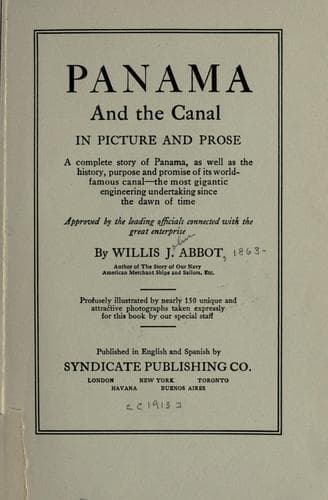
Panama and the Canal in Picture and Prose — John Shaqi
Panama and the Canal in Picture and ProseAbbot, Willis J. (Willis John)
History
Panama and the Canal in Picture and Prose
Abbot, Willis J. (Willis John)
Panama Canal (Panama) -- History
The rebuilding of Kingston, compelled by the earthquake, is proceeding
apace. The town will lose much in quaintness, one can see that by the
ruins of some of the older structures in which stately colonial outlines
can be traced. But it will gain in adaptation to the climate and the
ever-present earthquake menace. The main business street--King Street,
of course, being a British colony--is lined on either side with arcaded
concrete buildings of a uniform type. Ceilings are high, windows large
and one may walk the three long blocks of the busiest business section
without emerging from the shady arcades. The government buildings,
occupying two full squares and setting well back from the street, are of
a type that suggests the streets of India, and are also of reinforced
concrete. It is the belief of the authorities that the comparative
lightness of this material coupled with its resistant powers will enable
it to survive any earthquake. The whole period of the shock of 1907
barely exceeded ten seconds, but its wreckage will not be repaired in
ten years.
[Illustration: “GWINE TO DE BIG JOB”]
The cargo that we have taken on from the spice-scented dock is
technically called a “cargo of black ivory,” made up of negroes sailing
for Colon to work on the “big job.” Good-natured, grinning negroes
these, though I have heard that, on the smaller ships that carry them by
hundreds for the 500 miles for five dollars each, they sometimes riot
and make trouble. With us they were inoffensive, though it is perhaps as
well that the passenger quarters are to windward of them. The religious
sentiment is strong upon them and as the sun goes down in the waste of
waters the wail of hymn tunes sung to the accompaniment of a fiddle and
divers mouth organs rises over the whistle of the wind and the rumble of
the machinery. One can but reflect that ten years ago, before the coming
of Col. Gorgas and his sanitation system, three out of five of these
happy, cheerful blacks would never return alive from the Canal Zone.
Today they invite no more risk than a business man in Chicago going to
his office, and when their service is ended the United States government
is obligated to return them to Jamaica where for a time their money will
make them the idols of the markets, lanes and yards.
CHAPTER II
CRISTOBAL-COLON; AND THE PANAMA RAILROAD
Public-domain text, read in full here on John Shaqi.
Reviews
Reviews
No reviews yet
Be the first to share your thoughts on this work.
Join the Discussion
Join the discussion
Sign in to leave a comment or review.
Sign InorCreate an account