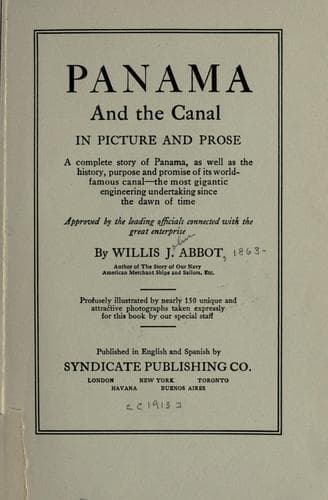
Panama and the Canal in Picture and ProseAbbot, Willis J. (Willis John)
History
Panama and the Canal in Picture and Prose
Abbot, Willis J. (Willis John)
Panama Canal (Panama) -- History
With the coming of the French, flush times began again on the Isthmus
and the golden flood poured most into Colon, as the Canal diggers made
their main base of operations there, unlike the Americans who struck at
nature’s fortifications all along the line, making their headquarters at
Culebra about the center of the Isthmus. But though the French failed to
dig the Canal they did win popularity on the Isthmus, and there are
regretful and uncomplimentary comparisons drawn in the cafés and other
meeting-places between the thrift and calculation of the Americans, and
the lavish prodigality of the French. Everything they bought was at
mining-camp prices and they adopted no such plan as the commissary
system now in vogue to save their workers from the rapacity of native
shopkeepers of all sorts.
[Illustration: SAN BLAS LUGGER PUTTING OUT TO SEA]
At Cristobal you are gravely taken to see the De Lesseps Palace, a huge
frame house with two wings, now in the last stages of decrepitude and
decay, but which you learn cost fabulous sums, was furnished and
decorated like a royal château and was the scene of bacchanalian feasts
that vied with those of the Romans in the days of Heliogabalus. At least
the native Panamanian will tell you this, and if you happen to enjoy his
reminiscences in the environment of a café you will conclude that in
starting the Canal the French consumed enough champagne to fill it.
[Illustration: THE ATLANTIC FLEET VISITS THE ISTHMUS]
Mr. Tracy Robinson, a charming chronicler of the events of a lifetime on
the Isthmus, says of this period: “From the time that operations were
well under way until the end, the state of things was like the life at
‘Red Hoss Mountain’ described by Eugene Field:
‘When the money flowed like likker....
With the joints all throwed wide open, and no sheriff to demur.’
Vice flourished. Gambling of every kind and every other form of
wickedness were common day and night. The blush of shame became
practically unknown.”
The De Lesseps house stands at what has been the most picturesque point
in the American town of Cristobal. Before it stands a really admirable
work of art, Columbus in the attitude of a protector toward a half-nude
Indian maiden who kneels at his side. After the fashion of a world
largely indifferent to art the name of the sculptor has been lost, but
the statue was cast in Turin, for Empress Eugénie, who gave it to the
Republic of Colombia when the French took up the Canal work. Buffeted
from site to site, standing for awhile betwixt the tracks in a railroad
freight yard, the spot on which it stood when viewed by the writer is
sentimentally ideal, for it overlooks the entrance to the Canal and
under the eyes of the Great Navigator, done in bronze, the ships of all
the world will pass and repass as they enter or leave the artificial
strait which gives substance to the Spaniard’s dream.
[Illustration: ROOSEVELT AVENUE, CRISTOBAL, ABOUT TO LOSE ITS BEAUTY]
Public-domain text, read in full here on John Shaqi.
Reviews
Reviews
No reviews yet
Be the first to share your thoughts on this work.
Join the Discussion
Join the discussion
Sign in to leave a comment or review.
Sign InorCreate an account