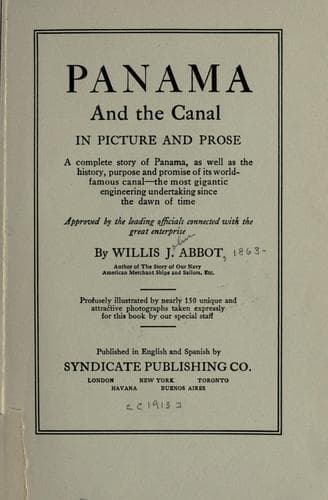
Panama and the Canal in Picture and ProseAbbot, Willis J. (Willis John)
History
Panama and the Canal in Picture and Prose
Abbot, Willis J. (Willis John)
Panama Canal (Panama) -- History
Before Porto Bello had even the beginnings of a town, before even the
settlement at Nombre de Dios had been begun, there landed at the former
port a Spaniard to whom the Isthmus gave immortality and a violent
death--two gifts of fortune which not uncommonly go hand in hand. Vasco
Nunez de Balboa was with Bastides in the visit which preceded that of
Columbus. Thereby he gained a knowledge of the coast and a taste for
seafaring adventure. Having tried to be a planter at Santo Domingo and
failed therein, he gave his creditors the slip by being carried in a
barrel aboard a ship about to explore the Panama coast under the
Bachelor Encisco. Though they laughed at him for a time as “_el hombre
de casco_”, “the man in a cask”, his new companions in time came to
accept his leadership and ultimately discarded that of Encisco, for
besides gallantry Balboa possessed a genius for intrigue. Except for his
great achievement of the discovery of the Pacific, and his genius in
making friends of the tribes he had subdued, Balboa’s career does not
differ greatly from that of the leaders of other remorseless Spanish
hordes who harried the hapless people of Central America, robbing,
enslaving and murdering them with brutal indifference to their rights
and totally callous to their sufferings. One can hardly read of the
Spaniards in Central America and Peru without sympathizing somewhat with
the Indian cacique who, having captured two of the marauders, fastened
them to the ground, propped open their jaws and poured molten gold down
their throats saying the while: “Here’s gold, Spaniards! Here’s gold.
Take a plenty; drink it down! Here’s more gold.”
[Illustration: SEVENTEENTH CENTURY RUIN AT PORTO BELLO
This edifice, still well preserved, is believed to be the Casa Real, or
Custom House]
Balboa was a pacifier as well as a fighter and it is recorded of him
that even on the warpath he was not unnecessarily brutal. Indeed one
cacique whom he overthrew was so impressed with his forbearance that he
entered into alliance with the Spaniard and gave him his favorite
daughter. Though he never married the girl Balboa “always lov’d and
cherish’d her very much”, according to Herrera, which is perhaps more
than some wives get with a wedding ceremony.
To anyone who has seen the Isthmian country as it is today, when the
stateliest native house is but a hut, and when it would appear that the
barest necessities of life are all that are sought by its people, the
story told by Herrera, the official historian of the Spanish court,
suggests a pitiful deterioration in the standard of native life. Of the
home and village of Comagre, the greatest cacique of the Darien region,
he writes:
Public-domain text, read in full here on John Shaqi.
Reviews
Reviews
No reviews yet
Be the first to share your thoughts on this work.
Elsewhere in the archive
Join the Discussion
Join the discussion
Sign in to leave a comment or review.
Sign InorCreate an account