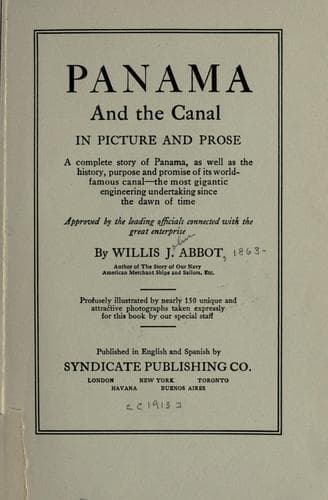
Panama and the Canal in Picture and ProseAbbot, Willis J. (Willis John)
History
Panama and the Canal in Picture and Prose
Abbot, Willis J. (Willis John)
Panama Canal (Panama) -- History
It was the Atlantic port of entry for not Panama alone, but for the
entire west coast of South America and for merchandise intended for the
Philippines. Its great days were of course the times of the annual fairs
which lasted from 40 to 60 days, but even at other times there were 40
vessels and numbers of flat boats occupied in the trade of the port. Yet
it was but an outpost in the jungle after all. No man alone dared tread
the royal road from the city’s gate after nightfall. In the streets
snakes, toads and the ugly iguana, which the natives devour eagerly,
were frequently to be seen. The native wild cat--called grandiloquently
a lion or a tiger--prowled in the suburbs and, besides carrying off
fowls and pigs, sometimes attacked human beings. The climate was better
than that of Nombre de Dios yet sufficiently unhealthful. Child-birth
was so often fatal and the rearing of children attended with so much
mortality that all mothers who were able resorted to Panama or Cruces at
such a time.
It was for a time a considerable market place and for the privilege of
trading there the brokers paid into the public coffer 2,000 ducats a
year. Another source of revenue was a tax of two reales on each head of
cattle slaughtered in the shambles--a tax still retained in form in the
Republic of Panama. He who brought in a negro slave had to pay two pesos
for the privilege and from this impost a revenue of some $1,000 a year
was obtained, most of which was used in cutting down the jungle and in
maintaining roads.
[Illustration: NATIVE FAMILY IN CHORRERA]
Public-domain text, read in full here on John Shaqi.
Reviews
Reviews
No reviews yet
Be the first to share your thoughts on this work.
Elsewhere in the archive
Join the Discussion
Join the discussion
Sign in to leave a comment or review.
Sign InorCreate an account