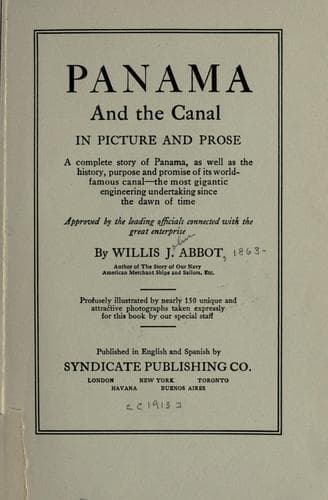
Panama and the Canal in Picture and ProseAbbot, Willis J. (Willis John)
History
Panama and the Canal in Picture and Prose
Abbot, Willis J. (Willis John)
Panama Canal (Panama) -- History
The return was made to Antigua where Balboa was received with loud
acclaim. Indeed he had accomplished the incredible. Not only had he
discovered a new ocean, not only had he brought home booty worth a
dukedom, but in the height of the rainy season he had marched 190 men
through the unknown jungle, fighting pitched battles almost every day,
taking food and drink where he could find it or going without, and
finally brought all back without losing a man. No expedition since, even
the peaceful scientific or surveying ones of our own days, has equaled
this record. He had left the Indians pacified, if resentful, and the
letter which he sent off to King Ferdinand was a modest report of a most
notable achievement. “In all his long letter,” says Peter Martyr, “there
is not a single leaf written which does not contain thanks to Almighty
God for deliverance from perils and preservation from many imminent
dangers.”
But Vasco Nunez de Balboa now approached the unhappy and undeserved
close of a glorious career. As his letter went slowly across the seas
in a clumsy galleon to Spain, one Pedrarias with a commission to govern
Balboa’s province and to deal out summary justice to Balboa, who had
been represented to the King as a treacherous villain, was on the
Atlantic making for the New World. When Ferdinand received Balboa’s
letter he would have given much to recall his hasty commission to
Pedrarias, but there was no wireless in those days, and the new
governor, with power of life and death over Balboa, was now well out at
sea.
The blow did not fall at once. On arrival at Santa Maria de la Antigua
in June, 1514, Pedrarias sent a courier to Balboa to announce his coming
and his authority. The devoted followers of Vasco Nunez were for
resisting the latter, assuring him that the King could not have received
the report of his notable discovery, else he would not thus have been
supplanted. Balboa however submitted gracefully, promising the newcomer
implicit obedience. Pedrarias, though charged to try Balboa for treason,
concealed his orders until he had gathered all the useful information
that the old chieftain could impart and won many of his followers to his
own personal support. Then he arrested Balboa and put him on trial, only
to have him triumphantly acquitted. Pedrarias was disgusted. He hated
Balboa and feared his influence in the colony. For his own part he was
tearing down the little kingdom his predecessor had erected.
[Illustration: WHAT THEY STILL CALL A ROAD IN PANAMA]
Public-domain text, read in full here on John Shaqi.
Reviews
Reviews
No reviews yet
Be the first to share your thoughts on this work.
Elsewhere in the archive
Join the Discussion
Join the discussion
Sign in to leave a comment or review.
Sign InorCreate an account