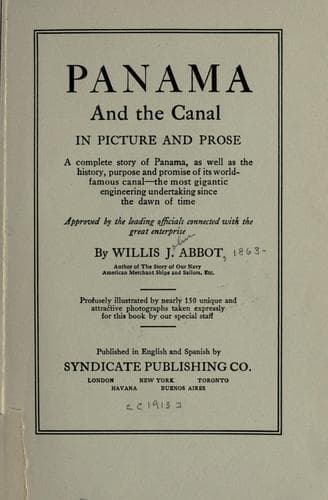
Panama and the Canal in Picture and ProseAbbot, Willis J. (Willis John)
History
Panama and the Canal in Picture and Prose
Abbot, Willis J. (Willis John)
Panama Canal (Panama) -- History
Balboa had fought the Indian tribes to their knees, then placated them,
freed them without torture and made them his allies. Pedrarias applied
the methods of the slave trader to the native population. Never was such
misery heaped upon an almost helpless foe, save when later his apt pupil
Pizarro invaded Peru. The natives were murdered, enslaved, robbed,
starved. As Bancroft says, “in addition to gold there were always women
for baptism, lust and slavery.” The whole Isthmus blazed with war, and
where Balboa had conquered without losing a man Pedrarias lost 70 in one
campaign. One of these raids was into the territory now known as the
Canal Zone. On one raid Balboa complained to the King there “was
perpetrated the greatest cruelty ever heard of in Arabian or Christian
country in any generation. And it is this. The captain and the surviving
Christians, while on this journey, took nearly 100 Indians of both
sexes, mostly women and children, fastened them with chains and
afterwards ordered them to be decapitated and scalped.”
[Illustration: OUTDOOR LIFE OF THE NATIVES
The tree is a mango so loaded with fruit that the boughs droop. The
fruit is seldom liked by others than natives]
Ill feeling rapidly increased between Pedrarias and Balboa. The former
with the jealousy and timidity of an old man continually suspected
Balboa of plotting against him. His suspicion was not allayed when royal
orders arrived from Spain creating Balboa adelantado and governor of the
newly discovered Pacific coast. The title sounded well but he would have
to fight to establish his government over the Indians and even then
Pedrarias would be his superior. But he determined to make the effort,
though with the whole Isthmus in war-paint because of the cruelties of
Pedrarias he would have to fight every inch of his way. Moreover he
tried to carry across the isthmus the hulls of four brigantines,
constructed on the Atlantic coast and designed to be put together on the
Pacific. Just why he attempted this exploit is perplexing, for there
were as good timber and better harbors for shipyards on the Pacific
side. Nearly 2000 Indian lives were sacrificed in the heart-rending task
of carrying these heavy burdens through the jungle, and when the task
was ended it was found that the timbers of two of the ships were
useless, having been honeycombed by worms. Two however were seaworthy
and with them he put forth into the Pacific, but a great school of
whales encountered near the Pearl Islands, where even today they are
frequently seen, affrighted his men who made him turn back.
Public-domain text, read in full here on John Shaqi.
Reviews
Reviews
No reviews yet
Be the first to share your thoughts on this work.
Elsewhere in the archive
Join the Discussion
Join the discussion
Sign in to leave a comment or review.
Sign InorCreate an account